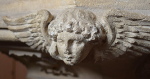
All Saints, Sudbourne

www.suffolkchurches.co.uk - a journey through the churches of Suffolk
|
All Saints, Sudbourne |
|
|
||
www.suffolkchurches.co.uk - a journey through the churches of Suffolk |
||


Follow these journeys as they happen at Last Of England Twitter.
| As you approach it from the west,
this church is one of East Suffolk's more memorable
sights, for it stands away from its village like a castle
on a hill above the approach road to Orford. Before the
tower of Orford's parish church of St Bartholomew was
rebuilt, it was easy to mistake Sudbourne church for
Orford's own. And yet as you get closer this apparent
grandeur is replaced by the simplicity of an ordinary
Suffolk parish church set in a rising churchyard. Beyond,
the narrow lanes wend through the forests and marshes to
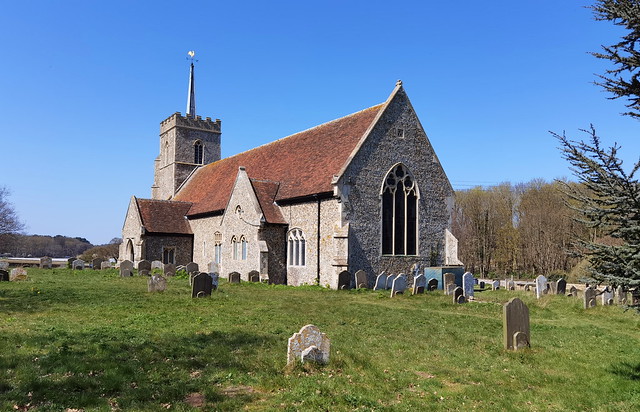
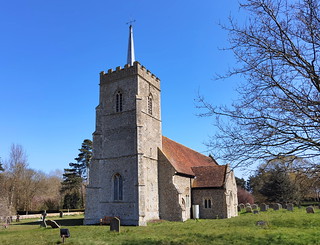
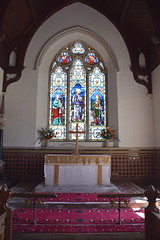
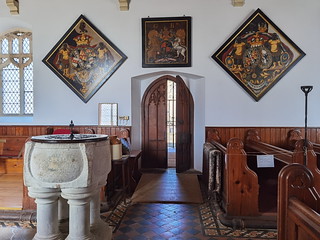
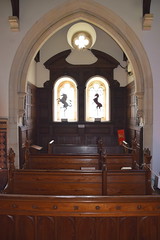
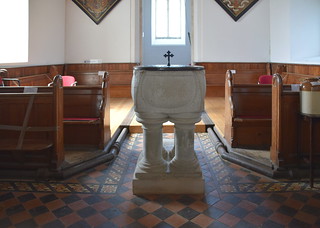
Iken and the drama of the River Alde. There are a couple of details that show there was once a Norman church here, and money was left in a bequest of 1426 to repair the chancel and build the porch on the south side of the nave, but the church was almost entirely rebuilt in 1878 by Frederick Barnes. It closed for a year for the rebuilding, and the renewed interior must have been quite a surprise for the parishioners when they came back. Little expense was spared, for the patron was Sir Richard Wallace of Sudbourne Hall, a regular employer of Barnes's services, and a name we will come back to in a moment. Barnes built the transepts, restored the tower, and reroofed the nave and chancel. The blocked Norman doorway on the south side of the nave was rediscovered at the time of the restoration. Most likely it had been filled in when the south porch was built. Arthur Mee claims to have entered the church through it in the 1930s, which seems a little unlikely. Its ranges recall similar work at Orford church and castle. The south porch is itself now blocked to form a vestry, and you enter through the north porch. Both porches have a pair of shields in the spandrels, one depicting the passion symbols, the other of the Holy Trinity. You step inside to Barnes's well-groomed interior of polished wood and glazed tiles. Sam Mortlock observed that the church is more like that of a prosperous Victorian suburb than of a remote East Anglian parish. It can seem rather dark inside, although not, I think, gloomy. It is easy to imagine the late 19th Century High Church services that must have taken place here. A number of hatchments hang at the west end about the tall tower arch and north entrance. Sir Richard Wallace donated the new organ here, in memory of his ancestors. He's perhaps better known for the art collection he bequeathed to the state, known today as the Wallace Collection. A large mortar, used for grinding corn, was set on modern shafts and pressed into service as the font. There is one identical to it elsewhere in Suffolk at Ashbocking. Wallace's organ is set into the north transept, which was built for the purpose. The south transept is designed as a family pew. Rather beleaguered up in the sanctuary is the grand memorial to Sir Michael Stanhope, who died in 1621. The monument takes up most of the north chancel wall, and looks a little out of place here, among the Tractarian furnishings, as if it were on an exotic holiday from Hawstead or Hengrave. The inscription tells us that he sat at the feet of Elizabeth I for twenty years. He was Privy Councillor, both to her and to James I. Now he kneels through all eternity in Sudbourne church. Below him is his wife Lady Anne all in black, and their daughters are before and behind her. The daughters have been reduced to stumps, and Lady Anne has lost her hands. Whether this is due to the anger of Puritans at their royal connections or simple carelessness over the years, I don't know. Outside in the churchyard are a number of 18th century headstones. One just to the south of the chancel has an inscription to Matthew Groom, who departed this life in 1769, at the age of 49. It tells us that The Boreas Blasts Neptunes Waves have tost me to and fro. Yet spite of both by God decreed I Harbour here below, Where I do now my Anchor lay with many of our Fleet. Yet once again I must set Sail our Admiral Christ to meet. It seems a suitable epitaph to find here, just two miles from the sea, and yet in what is wholly an agricultural setting. How often this parish must have sent its sons off to watery graves. |
Simon Knott, May 2021
Follow these journeys as they happen at Last Of England Twitter.





|
||||||||||||||||||||||||||||||||||||||||||||||||||||||
|
||||||||||||||||||||||||||||||||||||||||||||||||||||||
Amazon commission helps cover the running costs of this site