| |
Sudbury is
an attractive little town close to the border
with Essex, with which county the town shares a
boundary to the west and the south. Until well
into the 19th Century, Sudbury was the third
largest town in Suffolk after Ipswich and Bury St
Edmunds. It has fallen down the rankings since
then, but it did mean that during the medieval
period the town was large enough to be divided up
into separate parishes, leaving it today with
three substantial medieval churches, All Saints,
St Peter and St Gegory, the largest of the three.
All Saints lies to the south of the town centre
and its parish includes Ballingdon, south of the
Stour, which was in Essex until 1888. St Peter
sitsin an imposing position on the market place,
and until the Reformation it acted as a chapel of
ease to St Gregory, which is away from the
immediate town centre down by the river. After
the Reformation, St Peter became a separate
parish in its own right, but the church was
declared redundant in the 1970s. After years of
neglect it has recently been converted into an
arts centre.
All Saints and
St Peter both have wholly urban settings, hemmed
in by shops and housing. But St Gregory's aspect
has been opened up by the construction of the
adjacent ring road, which necessitated the
demolition of many of the houses of Gregory
Street and Croft Street. With the Croft, a large
grassed area leading down to the River Stour, and
Leonard Stokes's jewel-like 1890 Catholic church
of Our Lady and St John beside it, St Gregory has
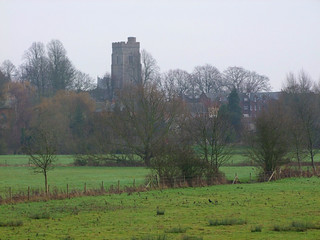
the loveliest setting of the three. When Sudbury
is seen from across the meadows, it is the tower
of St Gregory that dominates.
The late
medieval rebuilding of the church was achieved in
what seems to have been one long campaign lasting
about a century, which unrolled more or less from
west to east. A bequestr in 1384 by Peter Bory
left 6s 8d towards the making of the tower
there, suggesting that work was already
underway. The north aisle came as the gift of
Simon of Sudbury, Archbishop of Canterbury from
1375 to 1381, who met an unusual death for an
Archbishop and we will meet him again inside.
Then came the nave, clerestories and the south
aisle, the widening of the church necessitating a
new south porch which we will come to in a
moment. By the 1450 and 1460s, attention was
being paid to the nave furnishings. In 1457,
William Herward left 20 shillings (about a
thousand pounds in today's money) for the
painting of the image on the candlebeam of the
said church. Nine years later, Richard
Herward left another 20 shillings to the same
work.Last of all, the great chancel was built
right at the end of the 15th Century. As Pevsner
observed it is quite as long as the nave, and all
the more imposing for this. It was designed to
accommodate a college of priests.
The most
memorable approach to the church is from the
south, along the former line of Gregory Street.
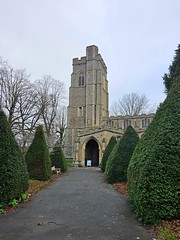
You enter the churchyard through an avenue
leading to the great south porch. The unfamiliar
width and shape of the porch is because it also
contains a chapel to the east of the entrance
which is entered from inside the church. They
were clearly built together, although they are
structurally separate wihin the shell of the
porch. There is something similar not far off at
Clare. A 1464 bequest made by Henry Sythyng left
forty shillings for a window to be made in
the chapel to have a better light, so this
may be around the time of its completion. The
chapel formerly contained the shrine of Our Lady
of Sudbury, although in later years it was used
as the last resting place of the Carter family.
Be that as it may, this is as grand an entrance
to any Suffolk church as you'll find, and you
step into an interior where the patina of age
survives, as well as a sense of the continuity of
its use.
The 19th
Century restoration here was the work of William
Butterfield, fresh from All Saints Margaret
Street in the early 1860s. He would provide
familiar echoes of that glorious London temple at
a number of East Anglian churches, but not here.
This is a pity in a way, for he might have
brought Alexander Gibbs or the Bell & Beckham
workshop along for the ride, but in fact the
glass here came twenty years or more after
Butterfield, the tamer work of Lavers, Barraud
& Westlake and of Heaton, Butler & Bayne,
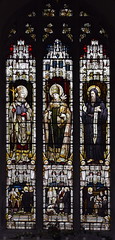
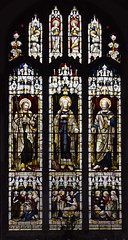
and their sequence of 19th Century glass saints
in the nave windows is imposing without being
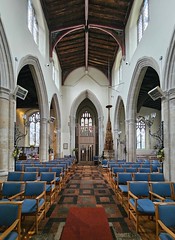
overwhelming. The benches that came with
Butterfield's restoration were curious affairs,
freestanding open structures. A minister I met
here once compared them to garden furniture, and
you could see why. Nevertheless they lasted into
the 21st Century, but they have now gone to be
replaced with modern chairs. The blue uphostery
of the new seating was perhaps intended to fit in
with the blue of Butterfield's restored canopy of
honour and chancel roof, though I'm told that
some people think them garish. They are certainly
better than Butterfield's benches, although
perhaps simple cane chairs would have looked
better, but of course they would not have been so
comfortable. It is hard to know what to do for
the best in such a situation, I suppose.
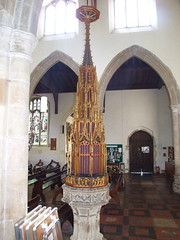
The west end
of the nave is dominated by a magnificent and
carefully restored 15th Century font cover. It
towers into space and is reminiscent of those at
Ufford and Worlingworth. The font beneath it is
unusual for East Anglia, for although early
Perpendicular in style (and so probably at least
half a century before its cover) it is
shallow-bowled and with simple tracery patterns.
It is probably contemporary with the rebuilding
of the north aisle, the font cover coming when
the body of the nave was completed and roughly
contemporary with the south porch. Perhaps it was
calculated to impress the pilgrims visiting the
shrine in the south porch chapel.
You step
through the chancel arch into the chancel, the
size of which is accentuated by its emptiness.
The windows are high in the late medieval
fashion, although oddly outside the tracery
continues downwards to create the more familiar
shapes of fifty years earlier. Among St Gregory's
medieval survivals are two curiosities. The first
is a single unrestored panel from the rood
screen, now hanging on the chancel wall. It
depicts Sir John Schorne, who, legend has it,
conjured the devil into a boot - or, because he
was invoked in prayers by those suffering from
gout, perhaps out of a boot. At some point the
panel seems to have fallen into the hands of a
private collector, possibly because it was
removed to safety at the time of the Reformation
by a member of the congregation with a special
devotion to Sir John. It later found its way to
Sudbury museum, who in more recent years returned
it to the church.
The other relic is the mummified head of the
aforementioned Archbishop of Canterbury Simon of
Sudbury. The architect of the Poll Tax when he
was made Lord Chancellor in 1380, his scheme led
to the Peasants Revolt the following year. He
took refuge in the Tower of London, where he was
messily beheaded by a lynch mob. It is said that
he was so unpopular that the guards simply waived
the protesters through. The head is kept in a
glass case in the vestry, but they'll show it to
you if you ask nicely.
Simon of Sudbury had founded a secular College of
Canons here in 1365. There was always plenty of
work to do in the English Catholic church - one
wonders how many large urban churches survived
without a college! - and it is little wonder that
the Reformation, and the switch to Anglican
congregational worship, put an end to them.
Nothing now remains. You might notice that there
is a statue of a bishop on the adjacent Croft,
and this might lead you to wonder if Sudbury was
proud of its wayward son Simon. In fact, this
statue is Aelfhun, an 8th Century Bishop of
Dunwich who died in Sudbury in about 798. He is
of significance here because the mention of this
death in the Anglo-Saxon Chronicle is the first
time that the placename Sudbury is recorded.
|