e-mail: simon@suffolkchurches.co.uk

All Saints, Sutton

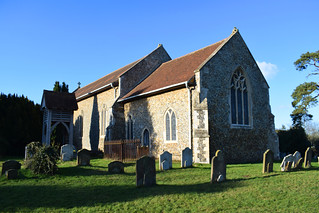
  It is unusual for a village to have a building of greater antiquity than its parish church, but the age of the largely Victorian-rebuilt All Saints at Sutton pales into insignificance in comparison with the barrows at Sutton Hoo, to the north of the village. Here, during the 1940s, Basil Brown of Ipswich Museum excavated a huge Anglo-Saxon ship burial, probably the final resting place of Redwald, King of East Anglia. The treasures are now in the British Museum, the burial helmet most familiar among them. It is easy to imagine Redwald's final journey across the heathland from Rendlesham, to this wild bluff overlooking the Deben.


All Saints. Surprisingly, prepare for a great wonder.

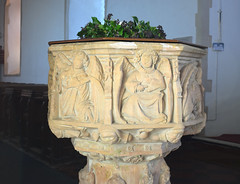
God the Father on the wonderful font.

  It is possible to visit the Sutton Hoo site, where there is a facinating museum and excavations are still in progress. But one should not ignore All Saints either. I didn't. I got here at the end of a 35 miles cycle journey, during which I'd dodged as many storms as I had visited churches. As I arrived here, another one broke.

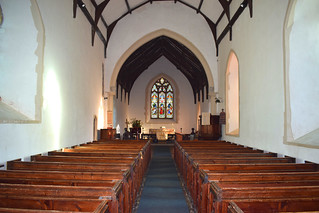
So often, you see a fine medieval church, and go in to the crushing disappointment of a complete Victorianisation. This is exactly the opposite.

This mainly Victorian church conceals one of the finest and most interesting fonts in the county. There is nothing else like it in all East Anglia. It has the 8 orders of the pre-Reformation church around the base, figures representing deacons, priests, bishops, mothers superior, etc.

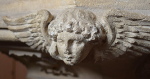
The supporting angels corbelling the bowl have, between them, the instruments of the Mass; paten, chalice, missal, etc.

The figures on the bowl are the four evangelists, interspersed with Mary Magdalene, Christ, the symbol of the Holy Spirit, and a very rare God the Father, the old man himself, seated on his throne. Dowsing would have a fit.  

Mary Magdalene,Ox of St Luke, St Gabriel. Beneath, a holy water pot and a missal, between members of the priestly heirarchy.


The rest of the church is neat and pleasant enough; even if the Victorians hadn't done it over, there wouldn't be much to see, since the whole thing burned down in the early 17th century.


The new belfry.

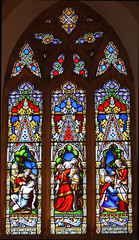
  And you wouldn't have what is quite the campest reredos in this part of Suffolk. The Millennium project was a little wooden belfry that stands to the south of the chancel.

It replaced a previous smaller turret, and is rather more ambitious than the one at nearby Alderton, but it seems a shame that you can't see the bell inside.

Unfortunately, there was no keyholder listed here, which seemed insane, given that the only thing of value in the church would need a crane to lift it. I had to use my magic wand to get in. However, I have since been told that the church is now kept open in the daytime.

This is good news - when I passed this way, it was the only church in this large benefice that I found locked.

The rain began to fall steadily, but I'd had enough. I headed on past Sutton Hoo, and the northern edge of the USAF base I'd passed the southern edge of 20 miles before, and on to Woodbridge. Getting wetter and wetter, I was picked up by my family and driven home.

 
  Halfway there, we broke down; the clutch had gone. Luckily, with three children in the back, we were a priority for the AA, so my wife didn't have to pull the 'my husband is suffering from hypothermia' trick, even if it was, by that stage, almost true.

Please also see the entry for this church at Aidan Semmens' Sylly Suffolk.

All Saints, Sutton, is on the B1083 Melton to Bawdsey road. Although I found it locked, I understand that it is now open. The church is hidden from the road, so look out for the sign.