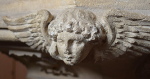
St Margaret, Syleham

www.suffolkchurches.co.uk - a journey through the churches of Suffolk
|
St Margaret, Syleham |
|
|
||
www.suffolkchurches.co.uk - a journey through the churches of Suffolk |
||


Follow these journeys as they happen at Last Of England Twitter.
| The little churches on the Suffolk
side of the Waveney valley are a delight. The busy road
between Diss and the sea runs on the Norfolk side of the
river, and so on the Suffolk side the quiet lanes can
meander and criss-cross as if they have nowhere in
particular to be, and nowhere to get to in a hurry. The
parish of Syleham consists of little more than straggles
of houses, and then up a track that runs between woodland
and fields you reach the lovely little church of St
Margaret. It is hard to imagine anything dramatic
happening in this pretty little spot, but almost nine
hundred years ago there was an event here that would echo
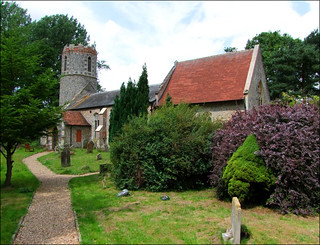
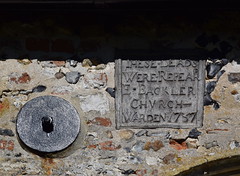
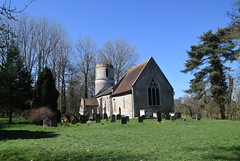
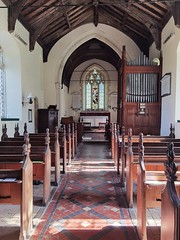
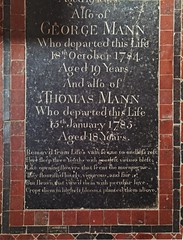
down the centuries, as we will see. The river is barely out of sight from the churchyard, and the boggy ground underfoot in places tells you how close we are to it. The exterior of the church is unusual, and one might even describe it as quirky, for the nave roof is so much lower than the chancel roof, and the perky tower rises almost awkwardly above them. In fact, the awkward juxtaposition of the nave and chancel roofs conceals the fact that the nave walls are higher than the chancel walls, it is just that the chancel roof is much steeper because the eastern gable is so tall. The nave appears to have been rebuilt towards the end of the medieval period, and as you can see from the roofline on the tower it was then as tall as the chancel roof. A lead plaque tells us that these leads were repeard by E Backler church warden 1737, which may possibly date the change.The flushworked bell stage of the tower is very much in the 14th Century style, and it seems likely that the round tower below it is not so very much older, although as Pevsner pointed out there are clear signs of Anglo-Saxon work in the north-west corner of the nave. Although not large, the flushworked south porch appears grand against the nave. You enter through it into a peaceful space, the little church strikingly narrow. In 1472 William Gryse of Brockdish just across the river left 13s 4d towards the making of the font. If it is the font in Syleham church today then it is surprisingly plain and oddly proportioned for its date. Even odder is its base which, as James Bettley points out in his revision of the Buildings of England volume for East Suffolk is Norman, probably the bowl of another font upside down. The cover is charming and probably locally made, with a date of 1667 on it. From earlier in the same century is the pulpit. It has to be said that the view east is dominated by the organ. In turn, the chancel is watched over by Heaton, Butler & Bayne's 1890s crucifixion in the east window with its familiar boiling clouds. A ledger stone remembers three young sons of the Mann family who died in the 1780s, with a poignant epitaph telling us that: Remov'd from Life's vain scene
to endless rest, A cross up by the road remembers an event that occured in this churchyard in 1174, for this is where Earl Bigod surrendered his loyalty to King Henry II in 1174, giving up his castles at Bungay and Framlingham as part of the price. The crown later awarded Framlingham to the Dukes of Norfolk, and it is interesting to think what happened in the centuries after. At Framlingham the cause of Mary I was championed, the castle sheltering her and a military force being assembled which made her accession as Queen inevitable. Thus, Lady Jane Grey did not achieve the throne and finish off the destruction of churches which had been begun by the advisors to her cousin Edward VI. If this had happened, there would be no rood screens, no wall paintings, no stained glass and, more to the point, probably no Church of England. Mary's death five years later resulted in the accession of her half-sister Elizabeth who would steer a middle course which, despite many bumps in the road ahead, would leave us the Church of England that we know today. |
Simon Knott, April 2023
Follow these journeys as they happen at Last Of England Twitter.


|
||||||||||||||||||||||||||||||||||||||||||||||||||||||