St Mary, Tattingstone

www.suffolkchurches.co.uk - a journey through the churches of Suffolk
|
St Mary, Tattingstone |
|
|
||
| home index e-mail what's new? | www.suffolkchurches.co.uk - a journey through the churches of Suffolk |
|


Follow these journeys as they happen at Last Of England Twitter.
I remember cycling
out this way one autumn afternoon in the 1980s, soon
after I'd moved to live in Ipswich. A few months before,
the fields and copses of Tattingstone Vale had been
flooded for Anglia Water's new Alton Water reservoir,
taking with them a farm and a few cottages, although the
mill was saved and moved to the Museum of East Anglian
Life in Stowmarket. The village was still a destination
for those who wanted to come and gawp at the vast still
sheet of blue-grey water that now cut the village in
half, and I was one of them. The shape of the lake is a
diving shark, with the two halves of Tattingstone
clustering around the narrowest bit. A wide bridge joins
the parts of the village, quite out of scale with them,
but no doubt a useful thing to have. And people continue
to come to Alton Water, to canoe, and to windsail, and to
cycle around the perimeter. It has become an Ipswich
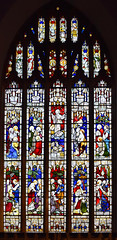
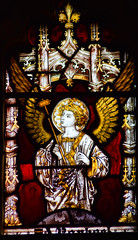
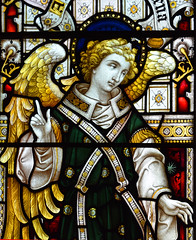
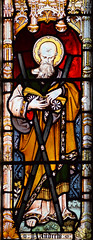
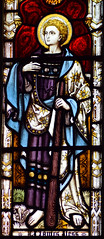
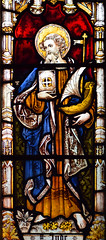
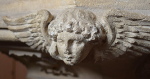
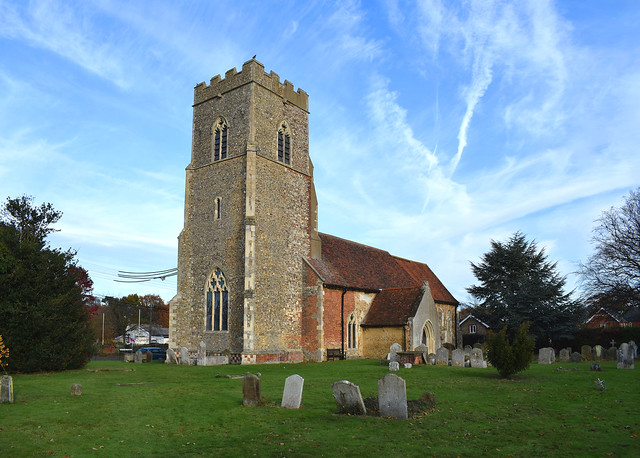
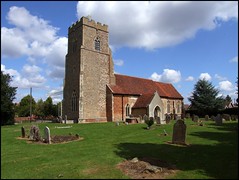
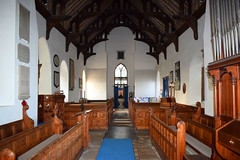
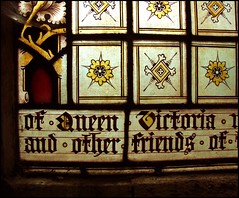
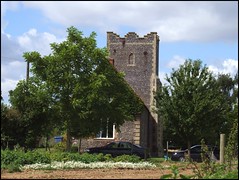
institution. The church is neat, bright and well-kept, all pink-cheeked as if fresh from its Victorian makeover, which was a notably good one. It was the work of Henry Hall, an architect whose work is found more often in domestic settings. The extent of the restoration is a reminder of quite what a parlous state the medieval churches of the east coast had fallen into by the middle years of the 19th century. Hall uncovered and restored the 15th Century double hammer beam roof, resisting the temptation to adorn it with mawkish angels, and the furnishings below are seemly and fitting for village worship. Best of all, the next twenty years saw the completion of one of the best schemes of glass in Suffolk by Clayton & Bell. If you stand across the road from St Mary you notice that the tower has two curious buttresses which emerge from the roof of the nave. These are much later than the tower, the decorated bell openings of which suggest a 14th Century origin, but the buttresses were probably part of a major overhaul in the 1680s, a time of renewed confidence in the Anglican church. The nave appears 14th Century too, suggesting that this end of the church is all of a piece, but the font, and some window tracery in the north wall of the nave, are perhaps a hundred years earlier. The chancel came a century in the other direction. Simon Cotton found Richard Wade's bequest of 1458 of tenement to the building of the chancel, and the following year Richard Sergeante left a pair of sheares to the building of the chancel, perhaps giving us an insight into the decade in which its rebuilding got underway. In the summer of 2008,
a churchwarden of another church pointed me in the
direction of a new book, called something snappy like 'A
Photographic Guide to the Churches of East Suffolk'. It
wasn't a bad book, just neither one thing or another, a
mugshot of the exterior of each church, and a brief
paragraph mostly culled from other sources. What had
struck the churchwarden though was that the author had
seen fit to say some unpleasant things about Tattingstone
church. This seemed extraordinary to me. I remembered St
Mary as clean and bright, full of 19th Century
atmosphere, and obviously well-loved and looked after.
Most importantly of all, it is open every day to pilgrims
and strangers. Going back then, and on several occasions
since, it is hard for me to see this interior as anything
other than one which must have rejoiced its parishioners
when they saw it for the first time in the 1860s, and
still pleases them now.
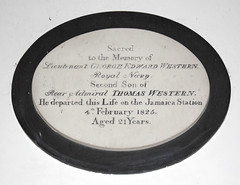
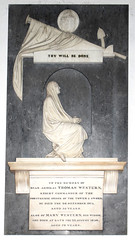
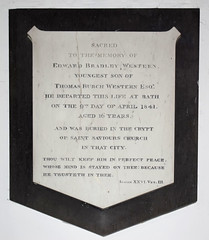
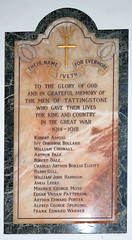
Hall's restoration preserved a number of memorials to the Western family of Tattingstone Place. The most memorable of these is to Rear-Admiral Thomas Western, Knight Commander of the Portugese Order of the Tower & Sword, who died on Boxing Day in 1814. It depicts the allegorical figure of Grief sitting beside a blank arcade beneath a draped anchor. It's by John Flaxman, one of only two memorials by him in Suffolk. Thomas's second son Lieutenant George Western has a simpler memorial of 1825 when he Departed this Life on the Jamaica Station. Edward Bradley Western, Thomas's 16 year old grandson, died in Bath in 1841 and was buried in the crypt of St Saviour's Church in that city. Near to this is a pressed copper plate memorial to Charles Arthur Boileau Elliot, the son of the Rector, who was killed in April 1917 during the Battle for Arras in the First World War. A Second Lieutenant in the 1st Somerset Light Infantry, Charles Elliot was just 24 years old, but he had already served at both Gallipoli and in Egypt. The memorial is somewhat wordier than we are used to for the early 20th Century, eulogising in an almost 18th Century manner: He died the noblest death a man could die, fighting for God & Right & Liberty, for such a death is immortality, it proclaims, lines from John Oxenham's 1915 poem To You Who Have Lost, and then it continues Death cannot long divide, for is it not as if the rose had climbed my garden wall and blossomed on the other side, a quotation from the mid-19th Century American poet Alice Cary, little-known today but who was popular at the time. It comes from her 1851 poem A Dream. Perhaps such sentiments were some comfort to his grieving parents, although it is hard for us to imagine how much at this distance in time. The plate is signed by Wm Morris & Co, Ruskin House, Rochester Row, Westminster. There was a fashion for these memorials in the years after the War, for they were inexpensive and could be produced quickly, but it is very much a period piece now.
As well as Alton Water, Tattingstone has two other points of interest that are worth seeking out. One sits about half a mile to the south of the church, and at first sight you might think this was a second church in the village, but in fact it is the 'Tattingstone Wonder', a cottage built in the shape of a church by landowner Thomas White in the 18th Century. You can see three photographs of it at the bottom of this page. In the other direction sits one of south Suffolk's best pubs, The White Horse. This ancient inn is hidden away on a road that disappears beneath the reservoir just beyond it, and is well worth a visit - as is the beautiful, interesting church of St Mary, whatever you might read about it in books. Simon Knott, October 2020 Follow these journeys as they happen at Last Of England Twitter. |





Amazon commission helps cover the running costs of this site