All Saints, Great Thurlow

www.suffolkchurches.co.uk - a journey through the churches of Suffolk
|
All Saints, Great Thurlow |
|
|
||
www.suffolkchurches.co.uk - a journey through the churches of Suffolk |
||

Follow these journeys as they happen at Last Of England Twitter.
| Great and Little Thurlow merge
into each other, forming a largish sleepy combined
village along the Newmarket to Haverhill road. The two
parish churches are at each end of the villages, set away
from the road among the older houses. Little Thurlow's
church is perhaps the better known of the two, being home
to the imposing and elaborate early 17th Century memorial
to Sir Stephen and Lady Ann Soane which fills the Soane
mausoleum chapel there. Also, Little Thurlow church is
open every day, which Great Thurlow church is not, but it
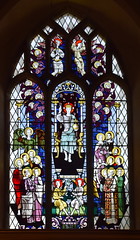
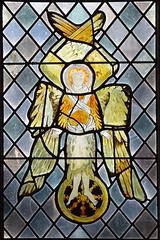
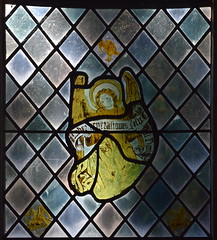
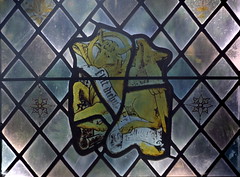
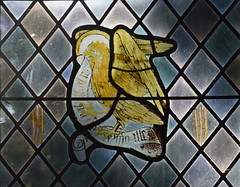
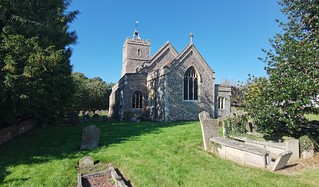
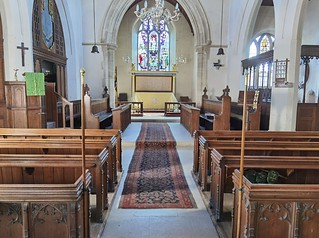
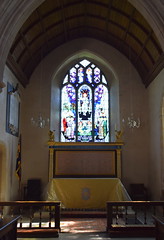
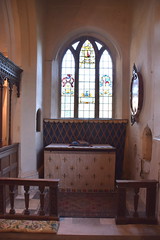
is equally of post-medieval interest. The church as we see it today is perhaps more typical of those just over the border in Cambridgeshire, with a battlemented nave rising above battlemented aisles. Pevsner recorded that the chancel showed structural signs of its Norman origins, but in any case the overwhelming impression is of a crisp 19th Century restoration, presumably that led by William Fawcett in the late 1870s. The leaded bell turret presumably predates this. Robert de Leck's will of 1378 left 1 quarter of wheat to the work of the church, the proceeds of which may well have gone towards the building of the late 14th Century tower. The nave and its aisles presumably followed not long after. As at Little Thurlow you enter the church from the north, and the first impression is of height and space. The most easterly bays of the two arcades contain the organ chamber on the north side and the Vestey Chapel on the right, and the view to the east is of a chancel that is filled with light. This is thanks to Harry Harvey's excellent late 1950s glass depicting Christ in Majesty, a scene often depicted with sombre gravitas but as usual Harvey manages to imbue it with a charming liveliness. Below the window the contemporary reredos by Laurence Bond makes its presence felt with scale and freshness. The light to the east is also contributed to by the glass in the Vestey chapel. The otherwise clear windows have two lozenges recording restorations of the church at two different times, the first telling us that James Vernon Esqr Lord of this Mannor repaired and beautified this church 1741. James Bettley in the revised Buildings of England volume for West Suffolk notes Michael Archer's attribution of this glass to William Price the Younger, who with his father and grandfather was responsible for the 18th Century glass in Westminster Abbey. The other lozenge records that Ronald Arthur Vestey Lord of this Manor & Florence Ellen MacLean his wife repaired and beautified this church 1956. It was made by Joan Howson, and this date marks the beginning of a scheme that also brought the Harry Harvey glass and the reredos. Howson was also responsible for arranging the old glass in the south chancel window. This consists of three restored 15th Century East Anglian angels standing on wheels, and four large evangelistic symbols, the winged man of St Matthew, the winged lion of St Mark, the winged calf of St Luke and the eagle of St John. These seem likely to be of the early 16th Century and are out of scale for a parish church, so presumably all this glass came from elsewhere originally.
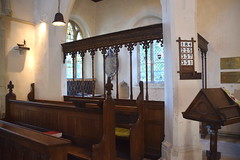
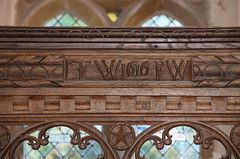
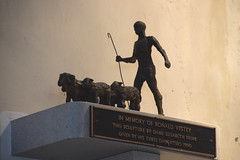
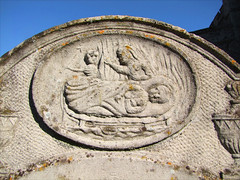
The elegant screen around the Vestey chapel is dated on the north side 1616, with the initials TW and FW. James Bettley thought it was likely to have come from the Warren family pew, and was incorporated into this new screen when it was erected in 1962 as part of the ongoing restoration. Beside it is Elisabeth Frink's 1990 memorial sculpture to Ronald Vestey, depicting a shepherd driving sheep. Frink was born and grew up in the Thurlows, and there is another memorial sculpture by her in the church at Little Thurlow. All in all, the view eastwards presents one of the very best 20th Century restorations of a Suffolk church. In fact, apart from the furnishings there is little to show that the Victorians were ever here. Fawcett removed the west gallery and plaster ceilings, presumably both fruits of the 1740s beautifying, to bring the church up to approved 19th Century standards. But the glass in the nave is mostly early 20th Century. The first window westwards on the south side depicts Elizabeth Canning as St Elizabeth presenting the young St John the Baptist to the Blessed Virgin and Christchild. She had died in 1899 and the glass is by J Cameron, an artist whose work is not found often in Suffolk, although he was also responsible for the Faith and Charity window at Groton. The other glass is by Heaton, Butler & Bayne when they were long past their best in the 1920s. Sam Mortlock, wandering in the churchyard in the 1980s for his Guide to Suffolk Churches, noted the headstone to Mary Traven who died at the age of thirty in 1897. It stands to the north-west of the tower, and a charming little medallion shows a woman in childbirth, and the midwife apparently trying to block out the skeleton of death by closing the curtains. Unfortunately, his leap into the room cannot be prevented. |
Simon Knott, September 2021
Follow these journeys as they happen at Last Of England Twitter.

|
||||||||||||||||||||||||||||||||||||||||||||||||||||||