St Peter, Little Thurlow

www.suffolkchurches.co.uk - a journey through the churches of Suffolk
|
St Peter, Little Thurlow |
|
|
||
www.suffolkchurches.co.uk - a journey through the churches of Suffolk |
||

Follow these journeys as they happen at Last Of England Twitter.
| The Bradleys, the Thurlows and the
Wrattings line the road from Newmarket to Haverhill, six
parishes variously Great or Little, but Little Thurlow is
the loveliest village and has the best church of the six
I think. In fact, Little and Great Thurlow run into each
other with a church at each end, Little Thurlow's the
more northerly of the two. When I first visited some
twenty years ago you had to get a key from a cottage in
the High Street, but nowadays the church is open every
day. You turn off the main road by a village green lined
with majestic horse chestnuts, and the church is just to
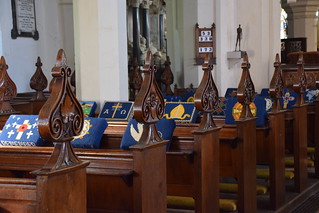
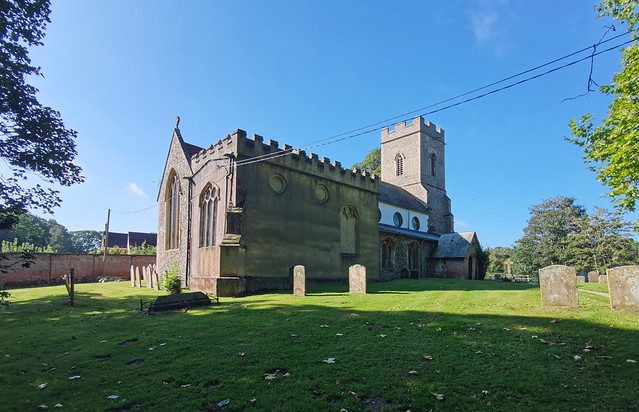
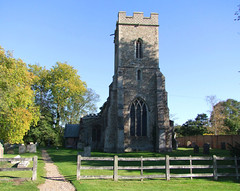
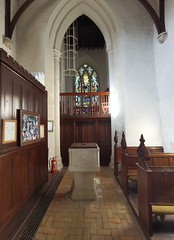
the east, by the infant River Stour. As often in this area the church is largely of the early 14th Century with 15th Century embellishments, but two hundred years later in the 1620s a large family mausoleum chapel was added to the east end of the north aisle. Its roofline is castellated, with blank Decorated tracery on the north side to match those in the aisle and a somewhat grander Decorated window at the east end. Given its date it is, as Pevsner said of something similar at Stow Bardolph in Norfolk, Gothic survival rather than Gothic revival. Only the blank round tracery on the west and side speaks of the century to come. As we will see inside, it is a tribute to the wealth and enthusiasms of the Soame family, who we have met a mile or so up the road at Little Bradley. The Soame mausoleum disguises that fact this is, in proportion, a big church. You step into the nave and the first impression is of the expanse of high dark wood furnishings. If the Soame mausoleum is late Gothic survival, these furnishings are early Gothic revival, for the church was extensively restored in 1843 and the woodwork was carried out by William Perry of nearby Clare. The benches are grand and handsome with tall bench ends most impressively carved.
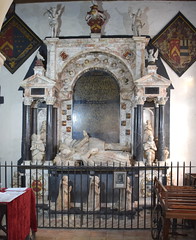
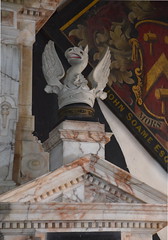
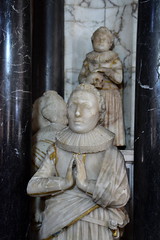
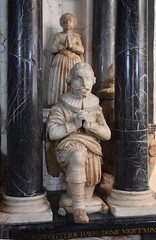
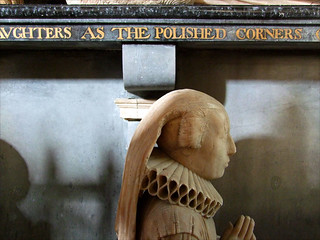
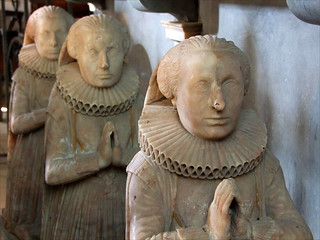
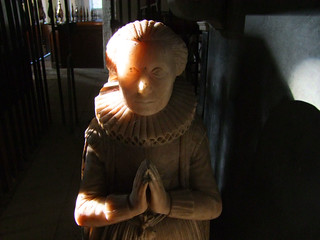
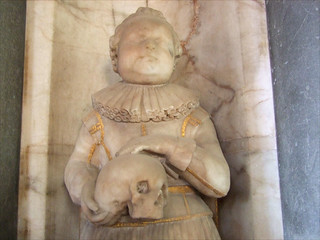
The contents of the Soane mausoleum are discreetly hidden from where you stand at the west end of the nave, but as you step through the chancel arch it unfolds to the north. Sir Stephen Soame and his wife Ann lie beneath one of the grandest memorials in Suffolk. Sir Stephen was Lord Mayor of London, and he died in 1619. While Sir Stephen and Lady Ann sleep on in their conventional reclining posture, they are surrounded by nine of their children in various poses and facing in different directions. The boys, although child-size in proportion, sport beards, and one of the girls strokes a skull as if it were a pet cat. Intriguingly, all the faces are slightly different - where they based on the life? Old Father Time on top waits for his chance.
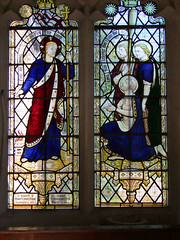
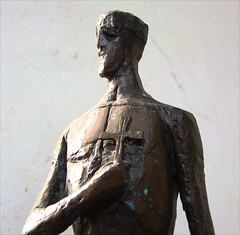
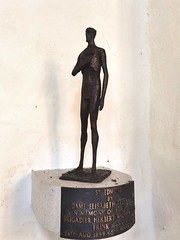
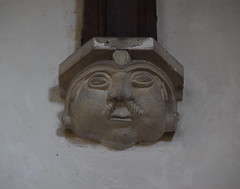
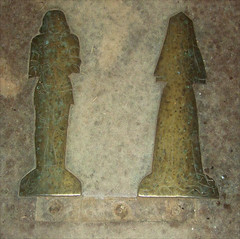
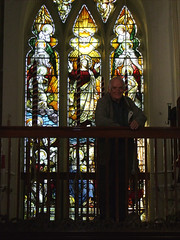
Easily missed is the glass in the oval window which faces west from the mausoleum. It is contemporary with the mausoleum, of the 1620s, a most unusual date for glass in Suffolk. In Coelo Quies it reads within a burst of glory, 'At Peace in Heaven', a motto more commonly encountered on hatchments. The late 1950s glass in the south aisle east window is by Geoffrey Webb and depicts Christ's commission to St Peter. It remembers Mabel and Frederick Frink. They were the grandparents of the sculptor Dame Elisabeth Frink who was born in their house in 1930. In the arcade of the north side of the nave is the maquette for Dame Elisabeth's sculpture of St Edmund which now stands in the cathedral grounds at Bury St Edmunds. It was placed here in memory of her father. The large square font appears to be late Norman, although I couldn't help wondering if it was actually a 19th Century reproduction. Looking up, there are some extraordinary corbels in the 14th Century style which appear to date from the 1840s restoration. Among the memorials there here is an early 16th Century figure believed to be to two William Walpole and his wife. There are five hatchments and other Soame memorials, including one signed by John Walsh, that highly-regarded memorial sculptor of the 18th Century. Perhaps most memorable is the late 18th Century inscription that James Bettley in the revised Buildings of England volume for West Suffolk points out under the tower, to a drowned bellringer: Beneath his fav'rite bell poor Andrews lies, No pitying Naiade heard his dying cries when in the Stour he fell: his spirit rose to brighter climes and left this world of woes. A cross fashioned from an aeroplane propeller remembers Lieutenant William Harold Ryder of the Yorks Hussars and RFC, who was killed by flying accident July 16th 1917. Ryder was the half-brother of the remarkable charity worker Baroness Sue Ryder of Warsaw. Their father was Charles Foster Ryder of Great Bradley Hall not far from Little Thurlow. Charles Ryder had bought the Great Bradley estate in 1896 shortly after William was born, although the family spent most of their time at their other estate in Yorkshire. Charles had five children by his first wife Anna and then four with his second wife Mabel, of which Sue Ryder, born 1924, was the youngest. After their adventures in post-war Poland, Baroness Ryder and her husband Leonard Cheshire would settle in nearby Cavendish where the Sue Ryder Foundation and the first Sue Ryder Home was established in 1953. |
Simon Knott, September 2021
Follow these journeys as they happen at Last Of England Twitter.




|
||||||||||||||||||||||||||||||||||||||||||||||||||||||