| |
|
 |
|
Thurston is a large and
busy village just off of the A14 not far from the
edge of Bury St Edmunds, with the blessing of its
own railway station on the Ipswich to Cambridge
line. The church sits on the edge of the village,
a large, crisp building that stands upright above
the road to Pakenham. None of the
rough-and-readiness of many of Suffolk's rural
churches here, for what you see from the road is
entirely of the 19th Century. On this site, we have often come
across the work of the unfashionable Victorian
Suffolk architect Edward Hakewill, son of the
more famous Henry Hakewill. He had worked
extensively in Suffolk the 1860s, and is
sometimes good, at Kenton, for instance. But he
can also be very undistinguished, as at Rushmere,
Brantham and Shottisham. The reason I was
intrigued by Thurston is that it was the work of
his lesser-known younger brother, John Henry
Hakewill, and I was interested to see what he
had got up to.
|
His brother Edward's usual approach
was to go in, build a north aisle, reduce the internal
furnishings to a polite middle-brow sacramentalism, and
then leave. John Hakewill had rather more than that to do
here, because of something that happened on the night of
Sunday March 18th 1860. In common with most Suffolk
churches, St Peter had been greatly neglected through the
18th and early 19th Centuries, and its need for a
facelift had become obvious. In fact, John Hakewill had
already been engaged as the architect for a thorough
going-over of the old structure. But shortly before
midnight, supposedly on the night before work was due to
commence, the tower fell.
It is hard to imagine the effect of an incident like that
on a tiny, remote, rural community. The one permanent,
ageless structure in its midst suddenly disappeared
overnight. The tower collapsed straight down, but falling
rubble took out the nave and aisle roofs, as well as
destroying piers of both arcades. The parishioners
decided to do the obvious, and retreat into the chancel
for services. However, just ten days later, the rest of
the nave collapsed, bringing down what remained of the
arcades and roofs, and destroying all the furnishings,
including the pulpit and lectern.
And so, a decision was made to rebuild from scratch,
accommodating the new church to the surviving chancel and
porch. As Roy Tricker points out, Hakewill was very much
of the prevailing opinion of the time that Decorated was
the only suitable style for a medieval church (despite
the fact that Suffolk's finest moments are mostly
Perpendicular), and, as a Bury Post article of
the time noted, Hakewill was determined that the new
church should be entirely in Decorated and correct
architecture, replacing the inferior architecture in the
old structure.
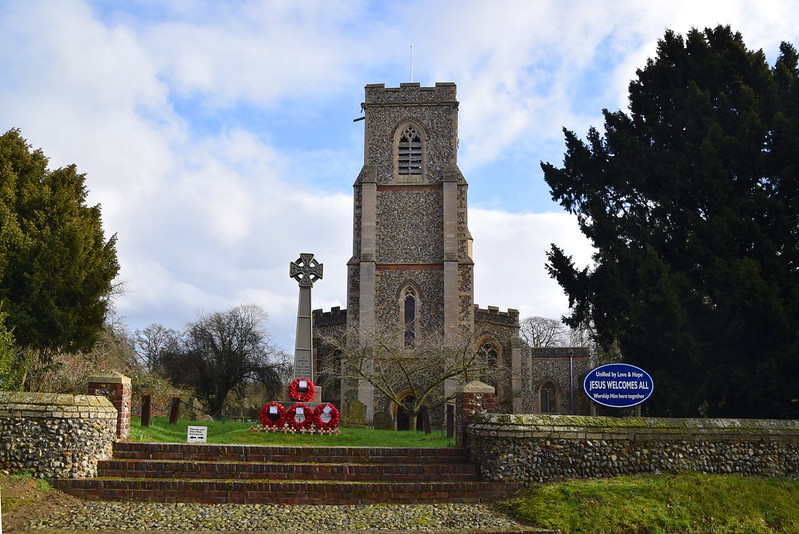
And so, there it is today. The exterior is certainly
impressive, and the church reopened barely 18 months
later, at the cost of about £3,500, about three quarters
of a million in today's money, an extraordinary bargain I
would have thought. This must have been a huge church,
even before Hakewill's rebuild - I wondered if it had
been a match for Rougham, across the A14. Much of the
chancel appears relatively original, despite considerable
patching up. The imposing tower itself is beginning to
mellow with age, although perhaps it still bears a
disconcerting similarity to what might be the tower of a
Typically English Village Church in a model village,
thanks to Hakewill's insistence on 'correct' Dec. But
when you consider what Richard Phipson did across the
road at Finborough and Woolpit during the same decade, St
Peter may have got off lightly.
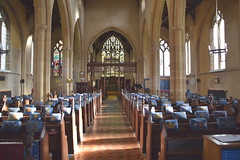
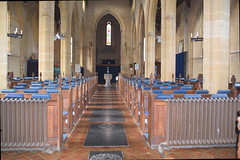
You step into a large, tidy space
full of light - no gloomy north aise here. Inevitably,
there is an urban feel to the wholly 19th Century
interior, although there are some earlier survivals. One
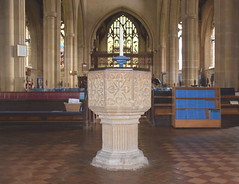
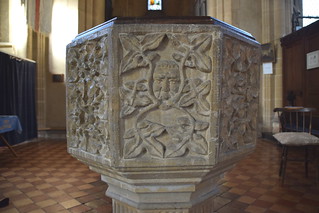
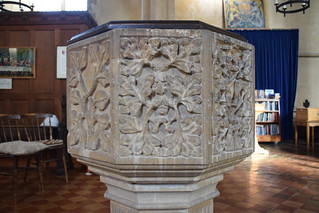
of these is the font, a fine perpendicular piece whose
foliage panels conceal a green man or two. Can it have
come from here originally? It is hard to see how the font
could have survived the collapse of the tower. There are
a couple more medieval benches now placed at the west end
of the south aisle, also with green men on them.
Bringing us right up to date is one
of Suffolk's several sets of royal arms to Queen
Elizabeth II (there are others not far off at Rattlesden
and Lavenham, among others). This set is dated 1977, the
year of the Silver Jubilee. The woodwork in the nave is
of a decent quality, presumably installed as part of the
same commission as the rebuilding, but the reredos in the
chancel is rather finer, the work of Father Ernest
Geldart, the Anglo-catholic carpenter-priest whose parish
and studio were at Little Braxted in Essex. Its
commission may give us some idea of the churchmanship
here at Thurston in the early years of the 20th Century.
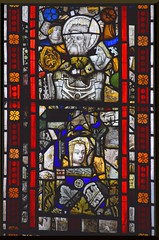
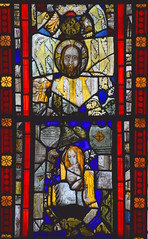
Collected fragments of 15th Century glass include a
number of striking heads, as well as parts of the figures
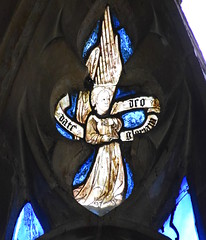
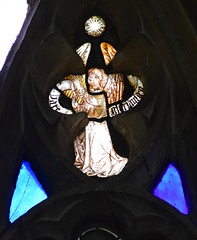
of a cherubim, a pope and a bishop. Up in the chancel
there is what appears to be a pair of delicious medieval
angels holding scrolls, although they are, I think, 19th
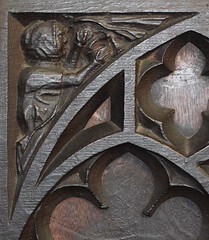
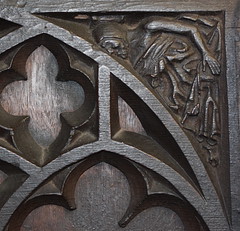
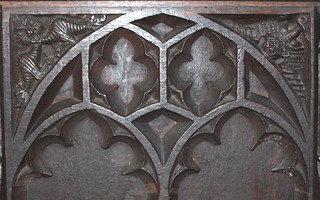
Century fakes. Certainly 15th Century are the stalls
below, however, which survived the fall of the tower and
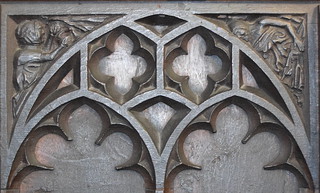
have delightful little figures in the spandrels. In one,
a woman mixes up medicine in a bowl while across from her
a man lies sick in bed. In other spandrels are dragon and
lions.
A name that many will associate
with Bury St Edmunds is that of the Greene King brewery,
and the Greene family are commemorated here at Thurston.
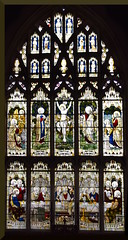
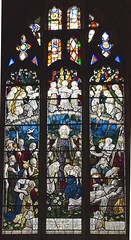
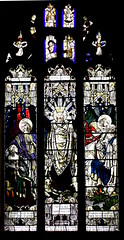
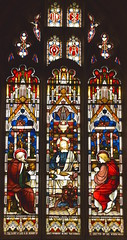
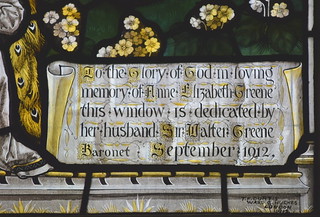
Sir Walter Greene paid for the restoration of the
chancel. The memorial windows to the Greene family are by
the stained glass firm Ward & Hughes, and were
installed over thirty years from 1890 to 1920. Ward &
Hughes were a company that went through three distinct
phases. In their early years they were often quite
interesting, as across the border at Pentney in
Norfolk, for example. Later in the 19th Century they
became one of the largest mass-producing workshops in the
country, churning out thousands of windows for hundreds
of churches all over the world that are largely of a
similar middle-brow quality. In the 20th Century,
however, the wheels came off a bit, and the windows vary
greatly. There is a feeling that patrons were given too
much say in the design, which is always a mistake, and
sometimes they can be pretty awful. But here at Thurston
the glass is spectacular.
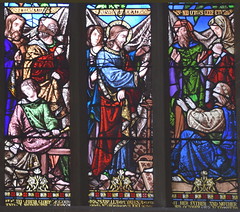
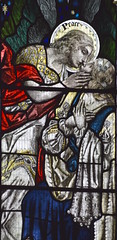
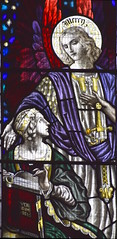
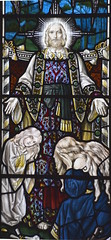
| The 1890 glass is
certainly not run-of-the-mill, being a version in
glass of Axel Ender's painting Easter Morning.
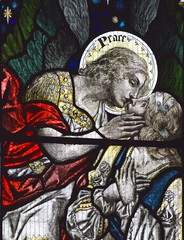
Whether it is good or not is perhaps a matter of
taste, but the other two windows are rather
thrilling, and delightfully mawkish - witness the
figure of Peace stooping to kiss the lips of
Righteousness. There is a Ward & Hughes
window in a similar style to these last two up
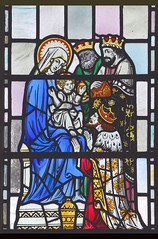
the road at Pakenham. Elsewhere
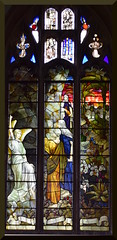
in the church, the lovely 1950 window of the
Adoration of the Magi at the east end of the
south aisle is by E L Armitage for Powell &
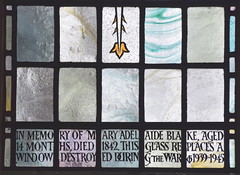
Sons, and it replaced damaged glass which
commemorated a 14 months old child, Mary Adelaide
Blake, who died in 1842. The date of the new
window suggests that the old one suffered blast
damge in the Second World War, a common fate for
these Suffolk churches surrounded by American air
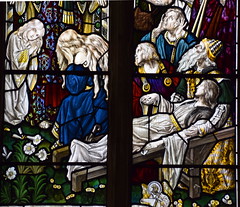
bases. The best window in the church, however, is
at the east end of the north aisle, and depicts
the Raising of Jairus's Daughter in a quiet,
painterly style. It remembers Isabella Blake, who
died in 1856, and nobody seems to know who it is
by. Intriguingly, given that this is also to a
daughter of the Blake family, it seems possible
that the lost window in the south aisle was by
the same workshop.
For many years, Thurston
church was difficult of access, so it is pleasing
to discover that it is now open to strangers and
pilgrims every day. Even more, the sign in the
porch asks you to be careful not to accidentally
lock the door on your way out.
|
|
 |
|
|
|