| |
|
|
|
|
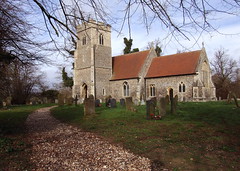
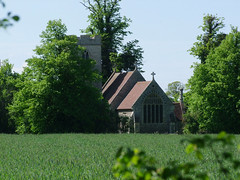
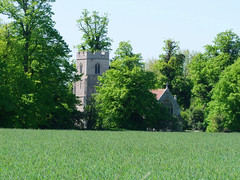
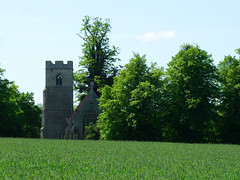
Timworth church is
visible off in the fields long before you reach it. You
cycle out of Ingham on the back road to Ampton, and soon
the lane curves widely through the meadows towards rising
ground and woodlands. Beyond them, unseen, is Ampton
Water, and ahead is Timworth church standing in splendid
isolation a good half a mile from the nearest other
building. You freewheel down to it on a narrow track
beside hilly fields, and when I first came here, on one
of the hottest days of 1999, it was like being in some
backwater of the Loire Valley. Coming back on a crisp
winter day in early 2008, an afternoon mist beginning to
condense out in the fields, the mood was quite different,
but no less beautiful. In later visits I've always found
the setting a delight. You reach the churchyard which is
sheltered by trees and rising towards the north. There is
a silence here which is difficult to find in the southern
half of England these days.
It is said that parish churches are often found a long
way from their village centres because inhabitants died,
or moved away, at the time of the Black Death. Of course,
there are a hundred and one reasons why a village church
should be remote, most of them economic, and these can
have just as dramatic an effect on people's lives as
pestilence does. Certainly, old photographs of the church
show buildings to the south of it, but no trace of them
remains. In fact, there is no village centre anymore.
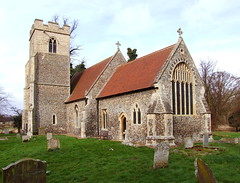
St Andrew has one of Suffolk's south towers, and as in
many cases the porch serves as the bell-ringing chamber,
so you walk in through hanging ropes. On the western door
jamb there is an interesting collection of 18th Century
graffiti. You step into the deep silence of a building
which is, to all intents and purposes, a Victorian church
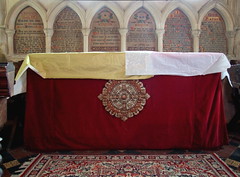
within a medieval shell. The reredos is identical to the
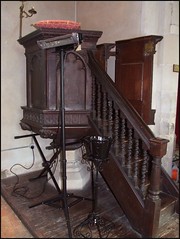
one at Culford a couple of miles off. The pulpit is huge,
with an ornate staircase looking like something out of a
French cathedral.
Perhaps it is the resonances of the early 20th Century
which are strongest, though. The war memorial has a
terrifying number of names on it for such a tiny parish.
A small plaque commemorates a fondly-remembered rector
from later in that century. The royal arms of William IV
survive from a hundred years or so before.
This is exactly the kind of church which should be open
all the time. Almost everything that was not not nailed
down has been taken by vandals and thieves decades ago
anyway. But what an act of witness to strangers and
pilgrims this building would be if it was always
accessible to pilgrims and strangers. The parish
population is tiny, and when I looked at the parish roll
in 2008 I found that only two local residents still
attended services here, other members of the congregation
coming in from elsewhere. And the Church of England has
begun to understand that the primary purpose of its
existence is not to serve the Sunday Club, but to be a
presence for all people. Now, increasing numbers of
remote, rural churches with tiny congregations are
altering their priorities to be such a presence. How
beautiful it would be if that could happen here.
|
|
|
|
|