St Andrew, Tostock

www.suffolkchurches.co.uk - a journey through the churches of Suffolk
|
St Andrew, Tostock |
|
|
||
www.suffolkchurches.co.uk - a journey through the churches of Suffolk |
||


Follow these journeys as they happen at Last Of England Twitter.
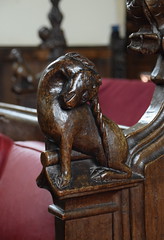
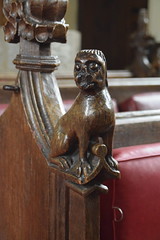
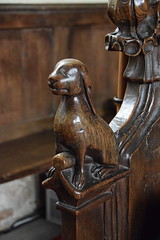
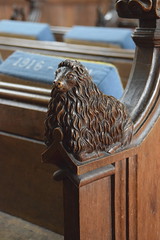
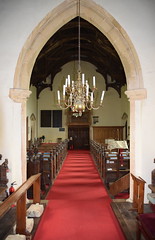
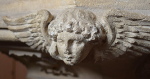
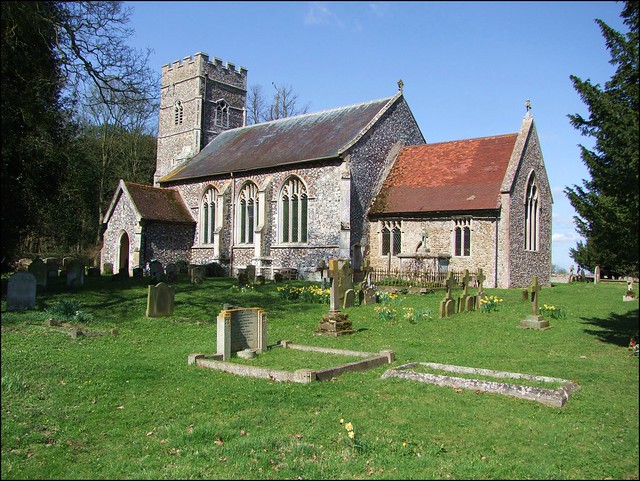
Tostock is just off of the busy A14, but the traffic noise is absorbed by the woodlands, and so you wouldn't know, and this is a peaceful place. Not many people visit St Andrew, and yet, it is kept open, and St Andrew has an interior which is nearly as interesting as that of Woolpit's mighty church on the other side of the dual-carriageway.Tostock church escaped the grand Perpendicular rebuild that just about every neighbouring church underwent, and so it appears less dramatic, but more homely, in its graveyard clearing. Externally, much of the church was as it is now in the 14th century. You step into an interior which appears wholly Victorianised, although in fact there are some splendid medieval survivals. The first that you'll notice are the medieval benches, with their animal bench ends. When you look at the style, especially with the traceried backs, they seem so similar to those at Woolpit that they surely come from the same workshop, as do the benches not so very far off at Combs. As at Woolpit and Combs, mostly they are restored or replaced 19th Century carvings, but some are 15th Century.
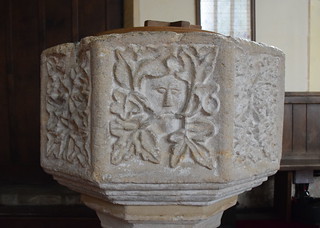
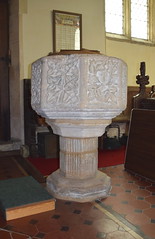
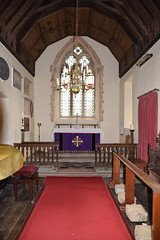
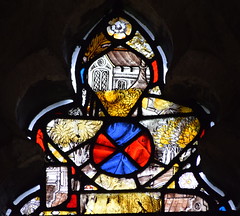
William Dowsing came this way on the afternoon of February 5th 1644, and smashed 16 panes of stained glass because of the Catholic imagery they contained. He gave orders for another 40 to be destroyed, but three rather pretty groups of fragments have been reset in the east window, one showing birds mobbing an owl who roosts in a tree above a herd of deer cropping. The font is a pattern book of Decorated windows, but on the north side a green man peers out of the foliage.
Dowsing also ordered
the steps up to the chancel to be levelled. These had
been put in about ten years before under the orders of
Bishop Wren, a staunch supporter of Laudian
sacramentalism. An inscription asking for prayers for the
dead was destroyed. Dowsing uses the word took, so it was
probably in brass. As John Blatchly observes in the new
edition of Dowsing's journal, it is unlikely that he was
responsible for the damage to the bench ends, since they
are all animals, as at Woolpit, which he also visited. Simon Knott, July 2019 Follow these journeys as they happen at Last Of England Twitter.
Amazon commission helps cover the running costs of this site
|