There is a trick
of making a place seem more remote than it actually is.
And, my goodness, this place seems remote. You reach
Washbrook just off of the busy roundabout where the A12
and A14 meet, and then climb away north from the pleasant
little village, along secret doglegging lanes that become
narrower and narrower. Hedgerows encroach, the roadway
dips and rises dramatically, and it doesn't take much to
imagine what it is like here in winter. Suddenly, you are
directed up a muddy track by a little wooden sign, and
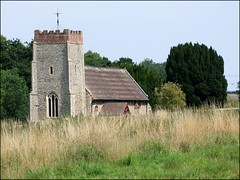
down into an intensely rural bowl-shaped graveyard, a
green sea of graves, within which St Mary is a ship,
floating steadily. The wind ripples the trees, and rooks
peel away over the ripening corn. We seem to be a very
long way from anywhere at all.
St Mary is in the care of the Churches Conservation
Trust, and this apparent remoteness was one of the
contributory causes of redundancy being declared in the
1990s. Matters had come to a head when the single figure
congregation were presented with a six figure restoration
bill. Washbrook parishioners here must now go to the
parish church at Copdock, which is actually closer to
Washbrook village than this one. Washbrook and Copdock
have been a joint civil and ecclesiastical parish for
years, and they have shared a Vicar since the
Reformation. As always, the CCT does a grand job here,
maintaining this fascinating building, which retains much
evidence of an interesting medieval liturgical life, as
well as a good 19th century restoration. The restorer
here was the great E. B. Lamb, and this is one of his
three major works in Suffolk, the others being Leiston
and Braiseworth. His are the striking red and black
banding in the roof tiles, also his the porch on the
south side, and what might be taken for a chapel (but
isn't) to the north, which enfold the 14th century tower.
You step into devotional dimness, the lowness and
narrowness of the nave, but this opens out into something
most unusual in predominantly Perpendicular East Anglia,
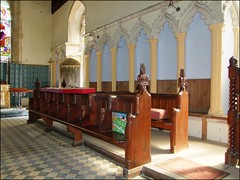
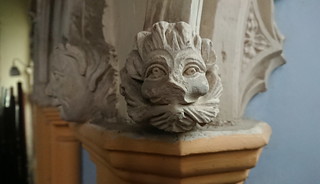
the collegiate chancel in the Decorated style. Stalls
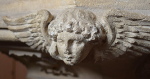
line the walls, all in niches with charming little heads
between them. They were recoloured as part of Lamb's
restoration, but there is no reason to think it wasn't
the original design. The 19th century glass beyond lends
more drama than it takes away, and there is a simply
beautiful Easter sepulchre in the north side of the
sanctuary. The whole piece, both Decorated and Victorian,
is breathtaking.
Stepping back down into the cool dimness of the nave, the
light from the south windows shafts across into what it
becomes apparent is a baptistery. Lamb retained the
medieval font and moved it into this little space,
recutting it and flanking it with angel glass to create
the right atmosphere, retaining at once a sense of its
rustic identity and the full self-confidence of the
period.
The best glass is on the north side of the nave,
commemorating the death of Queen Victoria in 1901. The
glass royal arms are probably the best of the period in
Suffolk, and VR is picked out in the quarries as if it
was a sacred monogram, which in a way it was of course.
There is another set of Victorian royal arms in plaster
above the entrance to the baptistery. In the lancets
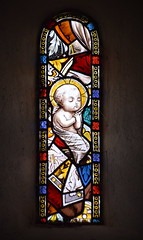
either side of the nave are collected what appear to be
19th Century studio offcuts, including an infant Christ
from a nativity scene. Odd things, they were probably
intended to resemble the collected medieval fragments
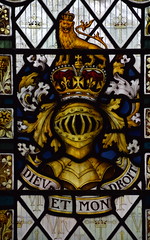
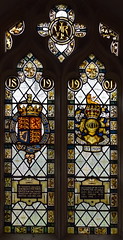
found in many East Anglian churches. Another curiosity is
the 1820s heraldic glass reset beneath the tower at the
end of the 19th Century. The central shield is flanked by
a vine on one side, a cornstook and sickle on the other,
in an entirely pre-ecclesiological style.
At the time of Domesday, Washbrook was known as Great
Belstead, the current Belstead parish being Little
Belstead. The brook which give the parish its modern name
flows a winding course to meet the Orwell at Bourne
Bridge. Like all Suffolk's rural parishes, Washbrook must
have been a busy place in Victorian times. One of the
buildings you pass on your way through the lanes is the
former school. And going back further in time, Washbrook
was big enough to maintain two parish churches before the
Reformation, the other serving the parish of the hamlet
of Felchurch, near to the Chattisham road. Hardly a trace
of it survives.
I suggested to you that the remoteness of this church was
an illusion, and I am afraid that it is. Climbing up the
ridge, the silence and birdsong are effaced by the
increasing noise of traffic at the busy junction below.
When I reached the top, I looked down. Not a quarter of a
mile away, the Tesco superstore shoulders Copdock Mill
interchange, an illuminated Pizza Hut hovers like a ufo
above B&M, here where the A12 and A14 twist in a knot
around each other. Beyond, the Chantry housing estate
loomed, home to 30,000 people, and the new space age
Suffolk One building. And then the centre of Ipswich
beyond, not three miles from where I now stood. Not far
short of a quarter of a million people could walk here
within an hour, now, but how many of them even know that
it exists, I wonder.