| |
|
Wattisham is a
fairly remote place, up in the hills beside a large
airfield, which cuts it off from its nearest neighbours.
It lost its parish church to redundancy back in the
1970s. I had only found this out when I tipped up in the
churchyard on a day of rain in late 2001, so it was with
some disappointment and even annoyance that I left the
village and headed on in the direction of Buxhall. And
then, I was surprised to find another graveyard on the
edge of the sleepy village. This one was quite different.
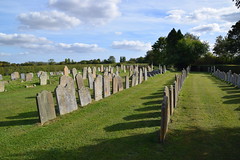
About 100 upright stones, all in neat rows across a
clipped lawn. At first, I thought that it might be an
overflow from the churchyard, but that was clearly not
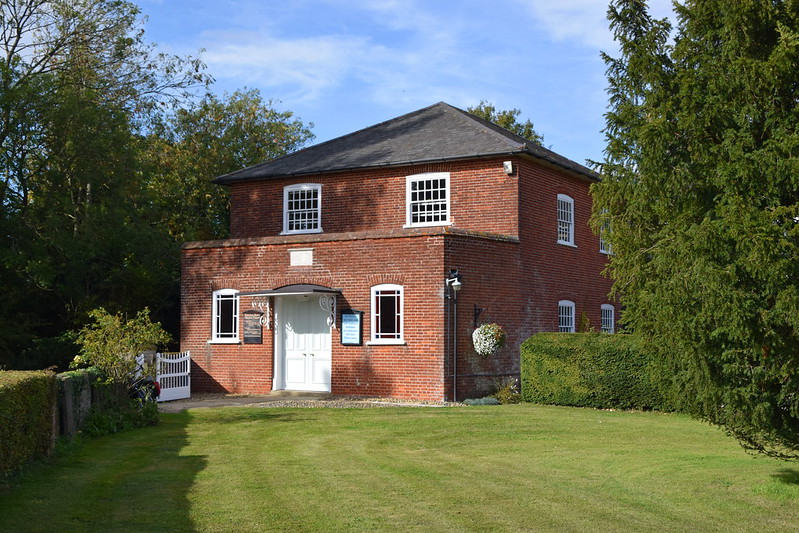
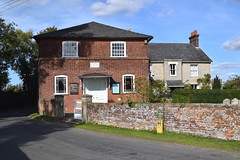
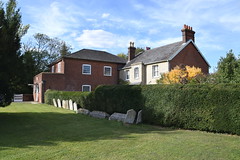
the case. An oddly shaped red brick building on the edge
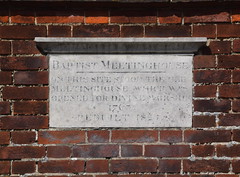
of the graveyard supplied the answer. An early 19th
Century structure, familiar from dozens of Suffolk
villages, but with the oddity of a cambered red brick
entrance porch, of the 1920s perhaps. Wattisham
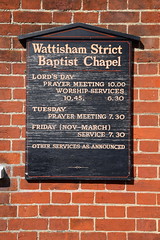
Strict Baptist Chapel said the sign. The busy
activities of the place were listed below. To the right
of the chapel stood a pleasant 19th century villa in
Woolpit brick, with the words The Manse on the
gate.
Rural Baptist churches are common enough in Suffolk. It
would be true to call Suffolk a Baptist county in the way
that some in the West Country are Methodist ones. The
independent Congregationalist tradition has always been a
strong one here. In Ipswich, there are probably as many
Baptists these days as there are Anglicans, on the large
housing estate where I work, there are three large,
modern Baptist churches, while the local Anglicans have
recently closed one of their two churches.
Be that as it may, this pretty little corner seemed an
incongruous find. For one moment, I might have imagined
myself in rural County Antrim rather than anywhere in
England. I thought that it would be interesting to take a
look. I got off my bike, and went into the graveyard. But
as I did so, it started to rain again. I tried the chapel
door, not expecting it to open - but it did, and I
stepped inside.I found myself in a light anteroom. There
was a little bookstall, with newspapers and magazines,
and a stairway led off to a gallery. Ahead of me, a
simple doorway led into the chapel itself, and I went
through it.
I felt as if I had stepped out of time. I was in a superb
early 19th century meeting house. The wooden gallery
swept around on three sides, supported by cast iron
pillars; there were contemporary benches beneath, all
focused on the reading podium at the far end. Everything
was well-kept, finely polished, and that was what made it
strange, I thought to myself. Where is the dust and
decay, the neglect I associate with church interiors of
this time? This place felt as if it had been cared for
constantly over the decades.
I sat for a while in silence, and then wandered about.
There was a highly polished parquet floor, and memorials
to former ministers around the walls. Immediately in
front of the podium was a modern light wood table and
chairs - for communion, I assume. I wondered if there was
a total immersion font in the space below. Outside the
clear windows, the rain had stopped, and the sun sent
shadows of branches scurrying across the woodwork.
I wandered back into the anteroom. I took a closer look
at the bookstall, and discovered that Wattisham Chapel
was a member of the Grace Baptist Association - or at
least, there was a pile of GBA directories, and I found
this church inside it. There was also a pile of a
newspaper called The Burning Bush - a protestant
witness in a day of apostasy, published by Kilskeery
Free Presbyterian Church, Omagh in County Tyrone. I
glanced carelessly at the opening sentence of the main
article: Tony Blair is the product of ecumenical
religion. He is said to carry a copy of the Koran in his
pocket and frequently peruses it.
Well, as you can imagine, I was hooked. This particular
edition of the newspaper was for October, and the whole
of it was taken up by responses to the previous month's
attacks on the World Trade Centre and the Pentagon.
Basically, it argued that, as well as targeting Osama Bin
Laden, the western industrial military complex should
also go after Sinn Fein. Whether it was actually
advocating the carpet bombing of republican west Belfast,
I wasn't clear. I read on, fascinated. Such terrible
events as those witnessed on Tuesday past are not a
matter of injustice to the victims but of mercy granted
to the living, it said. There is not one of us
who dies in what are termed "tragedies" but
deserves to! There is not one who escapes while others
perish who deserves to! All of us are worthy of death and
we can escape only by repenting and turning to Christ for
mercy and forgiveness. Wow. I turned to the back
page. One of the most horrific incidents... was
watching as poor people, demented by the heat and flames
behind them, hurled themselves into space in order to
escape those flames. Of course, there was no escape for
them in such action. But tonight, there is escape from
everlasting hell for you if you but take one step, the
step of faith, and come to Christ.
Well, they certainly weren't pulling any punches. I
leafed back through the paper. The gross hypocrisy of
Blair and the British Government cries out to heaven for
God's judgement. It won't be long in coming.
Slightly stunned, I stepped out into the clear daylight.
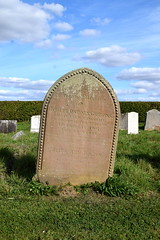
I wandered among the graves, most of the old ones
indecipherable now.
"Are you looking for someone?" said a voice
behind me. I turned to face a formidable old lady who had
followed me into the graveyard.
"Er, no", I stammered.
"It's just that lots of people come to the graves
looking for someone, and we have all the records
here."
It turned out that she was Mrs Hawkins, the Pastor's
wife, and when I explained my interest, she told me
something of the history of the place.
Originally, 18th century non-conformists from the local
villages had walked the fifteen-odd miles to Woolverstone
every Sunday. I imagined them, farm labourers mainly,
with their decent wives and poor children. They must have
thought it revolutionary to find a way to God without the
need to go through Parson and Squire first.
"They went to Woolverstone because the preaching
there was first class", Mrs Hawkins told me, as if
it was something that had happened last week. "But
in the end they found a man in their midst who could
preach to them, and they gathered around him here."
The preacher was everything. His name was John Hitchcock.
In 1889, an article in the East Anglian Daily Times
recalled the setting up of Suffolk's first Baptist
congregations, and noted that, within two years of
joining the Baptist church at Bildeston, John
Hitchcock,with a minority of the other members, resigned
from it over the question of free communion. This small
group joined Woolverstone Baptist church in the same year
(1759), a step which demanded of them a journey of
fifteen miles there and back every Sunday. They sustained
this for nearly four years, until on March 9th 1763, the
group, now numbering 28, was dismissed from Woolverstone
with the mission to set up a Church in its own
neighbourhood.
In the years of attendance at Woolverstone, John
Hitchcock had become their spiritual leader, and in the
autumn of 1763 he was solemnly set over them as their
honorary pastor. He was just 30 years old. Hitchcock led
them to build their first chapel on the current site. In
the 1840s, it was replaced by the current building.
"We still have all the records", said Mrs
Hawkins. "We still do things the same way now as we
did then. We still believe exactly the same things, and
sing the same hymns. We're very traditional. We still
wear hats."
She was forthright, and a bit formidable, but utterly
compelling. Drawn by her honesty, I asked a question I
rarely feel brave enough to ask people at churches.
Exactly how many people were in the congregation here?
"We get sixty or seventy", she replied.
"It goes up and down. People come because they like
what they hear. Sometimes they hear something they don't
like, and they stop coming. That's up to them. There are
always others who come to take their place."
I told her that I'd noticed that St Nicholas was now
closed. Did the villagers treat the Baptist chapel as if
it was now their parish church? She shook her head
vigorously. "No, they'd never do that. There's the
history, you see. The Anglicans and us. No, we're a
gathered congregation. People come here because of what
we preach."
Had her husband been here long? I wondered. He had been
Pastor for 37 years, she told me. He was chosen by the
people, and if they didn't like what he preached they
could throw him out. "But they never have", she
smiled. She talked about the Baptist tradition in
Suffolk, mentioning 17th and 18th century names that
meant nothing to me. "We're the same now as we were
then", she said. "We're still true
separatists." Separatists. I caught on the word, and
mentioned the Brethren community on the east side of
Ipswich, where I live. "Yes, that's right", she
enthused. "They practice Believers' Baptism and
preach the Bible. They're like us."
She paused. And then she said something quite
extraordinary. "We're truly ecumenical", she
said. "We'll stand firmly alongside anyone who
believes the same as us."
We said our farewells, and she invited me to visit them
one Sunday morning. This is the kind of invitation that I
often receive, but she made it sound as if it would be in
my interests rather than theirs. I hadn't told her that I
was a Catholic, of course, but I don't suppose that it
would have made much difference. From the Strict Baptist
point of view, we are all drowning or we are saved. There
isn't much point in distinguishing the drowning from each
other, Catholics from Anglicans, Pagans from Atheists.
That was seventeen years ago. Coming back in 2018, a
small part of me (well, quite a large part, really)
wondered if I would find the chapel closed, maybe
converted into a private house, perhaps a holiday home
for north Londoners. But there was no great difference.
Still the signboard with its service times, the neatly
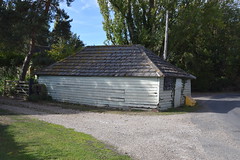
clipped lawn, the manse. One addition was that beside the
old stables across the road was a newly built car park
for, I suppose, some thirty cars.
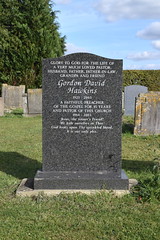
I went for a wander in the graveyard, and almost at once
found the headstone to Gordon Hawkins, the man who'd been
minister at the time of my first visit, and whose wife I
had spoken to. He'd died in 2003. There was space on the
headstone for his wife, but I must confess it pleased me
to notice that she had not yet been added to it, but was
still being formidable somewhere. I rather hoped that the
current inhabitants of the manse might see me wandering
and come out and chat, but it was not to be.
Since you are probably wondering, I must tell you that
this time I did not try the door to the chapel. I don't
really know why I didn't. Perhaps it would have been
open, perhaps not. If it had been so, and I had stepped
inside, it would have been like stepping back across
seventeen years of my life, seventeen years of all our
lives. I couldn't bring myself to do it. Sitting here the
same evening in the middle of Ipswich, I regret not doing
so. Obviously, I wish that I had.
As a Catholic, there is much in Baptist theology that I
find very difficult, if not wholly alien. It seems a hard
lesson - too harsh to sustain me, I think. I need
enfolding in the healing arms of sacramental love. But
you can't help admiring communities like this, what they
have done, and what they are doing now, separated, in our
midst.
Simon Knott, September 2018
|
|
|