| |
|
I'm a townie by
nature I suppose. Apart from the first three years of my
life, I have always lived in towns and cities.
Occasionally while out cycling I will pass through a
village and think to myself ooh, this is nice, I could
live here. But, as my wife needs often to remind me, the
novelty of living in the countryside would probably wear
off after the first eighteen hours or so.
And in any case, the Suffolk of the 20th Century is
disappearing. Post Offices, shops and pubs close, house
prices outstrip the means of locals, dairy farms succumb
to falling milk prices, children are bused to school in
the nearest town, and the jobs on the land evaporate as
the big supermarkets squeeze the life out of rural
England. Once, not so long ago, we weren't just
consumers. We used to make things, not just in
big factories in the cities, but in small workshops in
towns and villages. And we used to buy and sell our local
produce rather than driving weekly to a massive Tesco
store ten miles away.
We had a sense of community and interdependence. Now, we
have broadband. While her husband is something in the
City, a London designer can sequester herself in her
remote Suffolk second home and conference-call her
clients in the States, while her children downstairs
spend their time playing Fortnite or watching Youtubers
without ever meeting any of the local kids. Outside, the
land owned by her husband's pension fund is rapaciously
double-cropped by land agents using cheap migrant labour.
The East Anglian countryside that we knew only thirty
years ago has gone forever.
But there are still surviving communities in this
holocaust, settlements with shops and pubs around a wide
village green, where the lady in the post office still
calls you dear and passes the time of day with you, even
though there is a queue behind, villages where there is a
café and a petrol pump and even a secondhand bookshop,
and such a place is Westleton. It is one of my favourite
villages in all East Anglia, and if I am ever seized with
the mad impulse to get away from the hectic dynamism of
central Ipswich and head off to settle, and eventually to
die, in quiet rural retirement, it would be Westleton to
which I would choose to come.
While I have always been very fond of this village, I am
especially fond of its church. Back in 1990, it was the
first Suffolk village church which I properly explored,
and in later years I enjoyed finding my name from then in
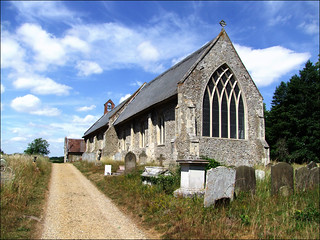
the visitors book. The wide open churchyard and towerless
church are hidden from the village street by a high
hedge, and it would be perfectly possible to pass through
Westleton without even noticing St Peter. Once on the
path that rises from the east, though, you find yourself
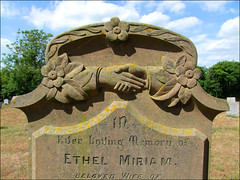
in a beautifully atmospheric churchyard, with more than
its fair share of interesting headstones. Several of them
provided the basis for stories in Ronald Fletcher's
In a Country Churchyard, recommended reading for all
fans of Suffolk churches. Among the graves that Fletcher
noticed is one for June Perry, a man, who was 'warrener'
for the royal family at Windsor from George III to Queen
Victoria.
The church appears long on its rise, the fine
interlocking Y-tracery of the east window like a spray of
flowers. At the west end is a curious buttress. The tower
fell in 1776, and the stubby replacement fell victim to a
World War II bomb. Its remains were demolished in the
1950s, but the little red-brick turret is perfectly in
keeping, and contains a bell from the 1960s. All in all,
it appears an undistinguished exterior. However, on
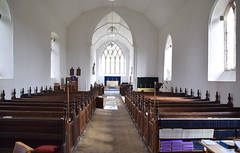
stepping inside, the first impression is one of surprise
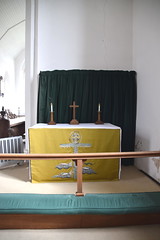
and delight. This is a cool, open, large interior. White
light falls across brick flooring and low doored pews. It
is enchanting. The Victorians were busy at Westleton, but
what could so easily have ended up as an anonymous, urban
restoration has left us instead a deliciously rustic
touchstone to our 19th Century forebears. The blacksmiths
and ploughboys of Victorian Westleton would still
recognise their church.
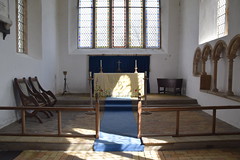
It is true that not much that is ancient has survived,
but the church has a good set of a 14th Century piscina
and adjacent sedilia in the chancel. Again, the feeling
is of a quiet, unchanging simplicity rather than
grandeur. There is another piscina in the south wall of
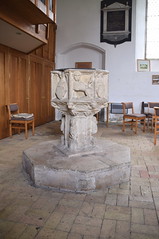
the nave, and at the west end the font seems to be from
the same workshop as neighbouring Darsham and Middleton.
The 19th Century benches are a curiosity. They are not
box pews, and have the customary Victorian medieval-style
poppyheads, but they also retain doors numbered in Gothic
scripted Roman numerals. They appear to date from the
church's 1857 restoration, but I haven't seen anything
quite like them elsewhere in Suffolk. To the east of the
north range is a grand prayer desk which Mortlock dated
to the 1930s and thought the work of a local Captain
Jackson - the finials depict a sower sowing and a
fisherman drawing in his nets. The nave is under a long
barrel-vaulted ceiling, incidentally the same as the
chancel at neighbouring Darsham.
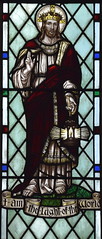
The 1940 window on the south side of the chancel is
notable because it is the only Suffolk work of Edward
Woore. That on the south side depicts St Felix and St
George. It is strikingly similar in organisation to
Margaret Edith Rope's window of the same decade a few
miles off at Chediston, though not as good I think.
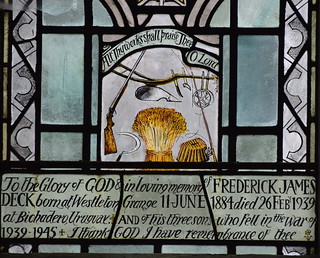
Beneath St Felix's feet is a panel depicting the tools of
a Suffolk farmworker half a century ago, a sickle, a
plough, a fishing rod, a shotgun and what I think must be
a wickerwork ferreting basket. All Thy Works Shall
Praise Thee O Lord says the line above from the
psalm: but how many of those works praise the Lord in
Suffolk today?
Simon
Knott, July 2019
Follow these journeys as they happen at Last Of England
Twitter.
  
| |
| |
|
|
|
|
|
|
|
| |
|
|
|
|
|
|
|
|
The Churches of East
Anglia websites are
non-profit-making, in fact they
are run at a loss. But if you
enjoy using them and find them
useful, a small contribution
towards the costs of web space,
train fares and the like would be
most gratefully received. You can
donate via Paypal.
|
|
|
|
|
|
|
|
|
|
|
|
|
|
|
|
|
|
|
|
|
|
|
|
| |
|
|
|
|
|
|
|
|
|
|
|
|
|
|
|
|
|