| |
|
It was the
beautiful late spring of 2019, and I was out for a bike
ride around the patchwork of little parishes to the west
of Ipswich with my friend Aidan, and eventually we
reached Whatfield, a comfy sort of village in the hills
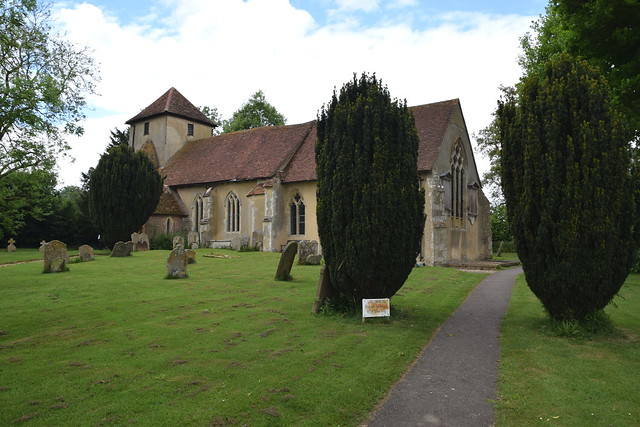
above Hadleigh, and St Margaret is in a delightful spot,
set back from the village high street in a cluster of old
cottages. The little church sprawls pleasingly among the
trees, a kink in the roofline giving it a slightly
hump-backed look. The truncated tower seems primitive, a
13th Century structure perhaps cut down to size and then
later rendered in cement, probably by the early
Victorians. An action like this is usually a sign that a
place fell on hard times after medieval prosperity, and
there was not enough money around during the 19th Century
Anglican revival to rebuild it properly.
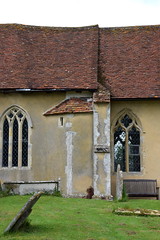
The body of the church is slightly later than the tower
and, although the Victorians were busy here too, Mortlock
thought the 19th century windows were probably fairly
accurate reproductions of what had been here before. All
in all the building is pleasingly irregular, and seems to
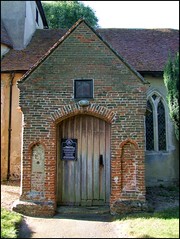
slope up towards the east. The red brick porch is early
16th century, and has the curiosity of two flanking
niches at ground level. The upper part seems to be
largely restored, but it would be interesting to know if
there were once niches there as well. The modern sundial
has weathered considerably since my first visit in the
1990s, giving me a sense of my own mortality, which was
one of the purposes of sundials in the early modern era.
It replaced a wooden 19th century one which is now inside
the porch, above the south doorway.
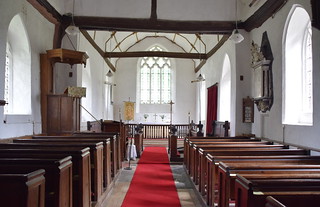
You step into a church which feels intimate and perhaps
even a little crowded, especially if you have come here
from the open light of neighbouring Elmsett. The west end
of the nave huddles under a fine 18th century west
gallery, and the roof above is entirely rustic, the
uneven ceiling rising above the roughly-hewn tie-beams.
The benches are a mixture, some Victorian, but one at
least dates from 1589, when John Wilson, presumably the
churchwarden, saw fit to have his name engraved upon it.
The view to the east is slightly curious. As is common in
this part of Suffolk there is no chancel arch, but the
space is filled above a roof beam to create a tympanum.
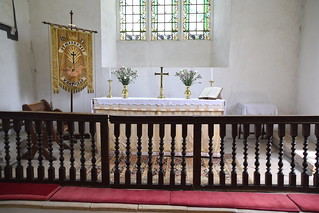
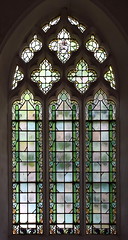
Beyond, the chancel is filled with coloured light from
the attractive east window with glass as jaunty as that
in an ice cream parlour The major restoration here was in
the late 1860s, but the glass and some of the furnishing
details have a feel of the later Art Nouveau movement to
them, and obviously date from the first years of the 20th
Century.
There are a number of other fascinating details. The
elegant 13th Century holy water stoup by the south
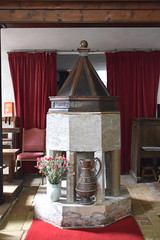
doorway is probably original to the rebuilding. By
contrast, the font of a century later is a plain,
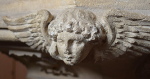
blockish thing. The wagon roof of the chancel is
punctuated by intriguing bosses of lions, kings and
bishops. Below, William Vesey's memorial from the end of
the 17th century appears grander than it would in a less
humble setting. All in all the sense is of a plain and
simple rustic building with a character all of its own,
and I like St Margaret all the more for that.
Simon
Knott, November 2019
Follow these journeys as they happen at Last Of England
Twitter.
  
Amazon commission helps cover the running
costs of this site
|
|
|