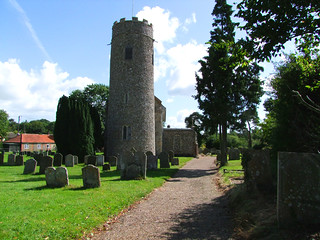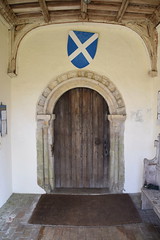
St Andrew, Wissett

www.suffolkchurches.co.uk - a journey through the churches of Suffolk
|
St Andrew, Wissett |
|
|
||
www.suffolkchurches.co.uk - a journey through the churches of Suffolk |
||
Follow these journeys as they happen at Last Of England Twitter. I loved coming back to Wissett in the early
spring, on one of those days which are still hard to
believe given how long the winter has been. The birds
seemed pleased with the day as well, providing a
soundtrack to my long freewheel down the hill from
Spexhall. I crossed the busy Halesworth to Harleston
road, pushing my bike across the little wooden bridge
which spans the drainage ditch along the north side of
the churchyard. It is there for a good reason, for in
1968 the flood water rose so high here that the organ was
destroyed.
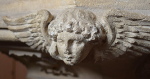
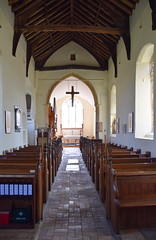
Three of them are angels. One of them is kneeling and holding a chain, and so is obviously a censing angel from a veneration scene of Christ on the cross. The other two appear sad, perhaps pensive, but I think their expressions are intended as awe, because the angle of their heads suggests they are looking down at a Nativity scene, in which angels were traditionally shown leaning on the walls of the stable looking down. The size of the three angels an idea of the scale of the lost scenes they came from, and the extent of that which we have lost. The other figure is a venerable and heavily bearded St John the Baptist, who does not look quite as severe as the Gospels might have suggested him. Indeed, he appears to be playfully tickling his little lamb. The surviving legend with part of his name below him is decorated with barleycorns, the hallmark of the Norwich school of glass makers. Under the tower, boards record feats of bellringing carried out towards the end of the 19th Century, while another board reminds us that the tradition survives here, giving times of service and practice. Even more recent is Peter Ball's sinuous sculpture of St Andrew set in a medieval image niche in a window splay on the south side of the nave. His work will be familiar to visitors to Ely and other cathedrals. The straw cross hanging in the chancel arch was produced for a flower festival back in 1973. This struck me as a mark, not only of continuity, but of resilience. Another reminder, if we needed it, that the main destiny of our medieval churches is not to be contemporary worship spaces, but to be the soul in stone at the heart of their communities, and as witnesses to larger truths, just by raising their heads above the rooftops and above the fields. Simon Knott, April 2019 Follow these journeys as they happen at Last Of England Twitter. |



Amazon commission helps cover the running costs of this site