St Mary, Wortham

www.suffolkchurches.co.uk - a journey through the churches of Suffolk
|
St Mary, Wortham |
|
|
||
www.suffolkchurches.co.uk - a journey through the churches of Suffolk |
||

Follow these journeys as they happen at Last Of England Twitter.
| You could easily visit the village
of Wortham without seeing this church. The parish
contains five settlements scattered around Suffolk's
biggest common, and the large village which takes the
parish name is on the busy Bury to Diss road. St Mary by
contrast is on its own, a mile or so to the north on an
ancient backroad that runs between Palgrave and Redgrave.
Between the church and the village stretches the ancient
common, gorse-covered now that it is undergrazed, bleak
and mysterious in winter, verdant in summer. It's a
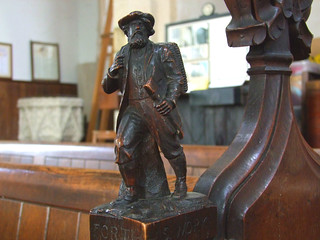
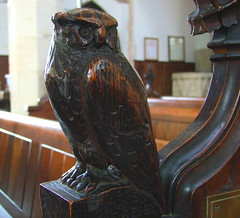
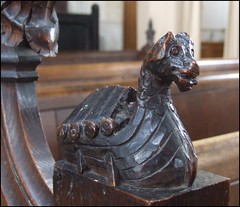
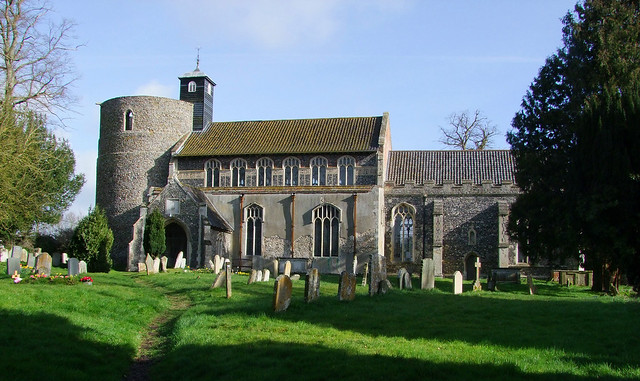
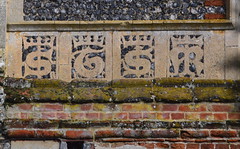
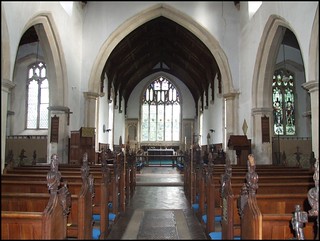
strange place. Wortham church has the biggest round tower in England, fully ten metres across. Round towers are an East Anglian speciality, apart from a handful in the Ouse valley in Sussex, and are a source of some wild speculation. The Saxon origins of some of the towers have encouraged people to suggest that they were fortifications, and only had churches added to them when the Normans came. However, almost all East Anglia's round towers post-date the Norman invasion. Indeed, some appear to have been built as late as the early 14th Century, and many of them are not as old as the churches against which they stand. Bramfield's is the only round tower in Suffolk that is separate from its church building, suggesting that they were always ecclesial in character. The most outlandish explanation is that they are the linings of ancient wells, left exposed as the land receded. This is pure nonsense, of course, but charming in its way. They were all probably built as church towers, and may have been intended as lookout towers as well, for why not? But it is hard to look at the mighty bulk of Wortham tower and not think that it might have had some kind of defensive purpose as well. I fondly remember being here once on a lovely day in early summer around the turn of the century I should think. I had cycled the four miles from Palgrave along the narrow lane in a shimmering heat. There were no cars about, not a person to be seen. A big golden hare sat watchfully in the verge, hauling himself back into the hedgerow as I approached. Off to my right, a line of low hills was punctuated by church towers, one of them round and only a few fields away, but they were all on the far side of the Waveney in Norfolk. The setting is lovely, a large, rising churchyard set in the fields with just a few big old houses and a farm for company. Although you can't go inside the tower, you can see the inside of it from the west. It probably dates from the early 12th Century. It is open to the sky now after the roof collapsed in the 1780s, but you can make out where the internal floors were, and what looks like it might have been a fireplace.The perky little bellcote was added at the end of the 18th Century. St Mary's tower is so striking that it it might distract from what is otherwise a harmonious late medieval East Anglian church with aisles and a clerestory,. It seems to be the work of one long building campaign from the late 14th to the late 15th Century. There are flushwork letters and symbols in the clerestory including four monograms reading S(anc)t(u)s Th(omas)e S(anc)ta A(ve) M(aria) R(egina) ('St Thomas, Hail Mary Holy Queen'). There was a lot of small-scale work done right at the end of the 19th Century by Albert Bartrum, who was not only a builder but the churchwarden here. You see the most memorable part of his idiosyncratic restoration when you step inside to the wide and well-kept interior which, perhaps thanks to his efforts, doesn't feel particularly rustic. We could be in the middle of a small town. The wide range of bench ends appear to be the work of Albert Bartrum himself, and were supposedly inspired by verses of the 104th Psalm, although perhaps it was a loose inspiration. As well as various figures going about their business, the bench ends include a walrus, a tortoise and an owl, a dragon and what appears to be a Viking longship. A bench in the south aisle has blacksmiths tools carved on it, perhaps to remember someone who once regularly sat there.
Most of the other furnishings were
renewed as part of a series of vigorous restorations
during the second half of the 19th Century, mostly under
the eyes of one of Suffolk's most notable ministers,
Richard Cobbold. He was rector here for more than fifty
years, and he oversaw the turnaround in the Church of
England that transformed St Mary from a preaching hall to
a sacramental house of God. He is more familiar to
historians as the author of the notes that became Biography
of a Victorian Village, probably the best single
account of Suffolk in the 19th Century. Incomprehensibly
it is now out of print, although easy enough to obtain
second-hand. Because of it, we know more about Wortham in
the 19th Century than perhaps any other Suffolk parish.
He also wrote the novel The History of Margaret
Catchpole, a bestseller in its day, a stirring
adventure of smuggling on the Suffolk coast. The novel is
remembered by a blue plaque on St Margaret's Green in
Ipswich on the house where the real Margaret lived as a
servant to Richard Cobbold's mother Elizabeth, and
elsewhere in Ipswich in the name of the pub beside the
grounds of the former Cobbold family home in Cliff Lane.
Richard Cobbold himself is remembered by a modest
memorial on the chancel wall here, that's all. Not far from this churchyard along the road to Redgrave sits a modest memorial in the corner of a field. It remembers events of the early 1930s, when non-churchgoing landowners fought for the right not to pay tithes to the church for its upkeep. Roland and Doreen Rash of Wortham Manor Farm campaigned against what was seen as a gross injustice by many farmers in this area, some of whom were non-conformists but were still expected to pay. Doreen Rash was better known as the novelist Doreen Wallace, a hardy fighter who documented the events of the time in her book The Tithe War. The Rashes were supported in their struggle by the blackshirts of the British Union of Fascists, who defended the Rash's farm against attempts by bailiffs recruited from the north of England to sequester their produce, in an incident which became known as the Siege of Wortham. Hard to imagine now. Roland Rash's brothers Arnold and Ralph, who fell at Passchendaele and on the Somme, are remembered by a window in the south aisle of the church. |
Simon Knott, December 2020
Follow these journeys as they happen at Last Of England Twitter.






Amazon commission helps cover the running costs of this site