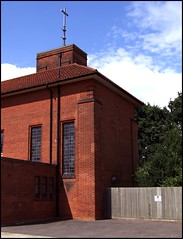
| Perhaps the most famous
power station in all England is Bankside,
now converted to become the fabulous Tate
Modern gallery. All Hallows has the same
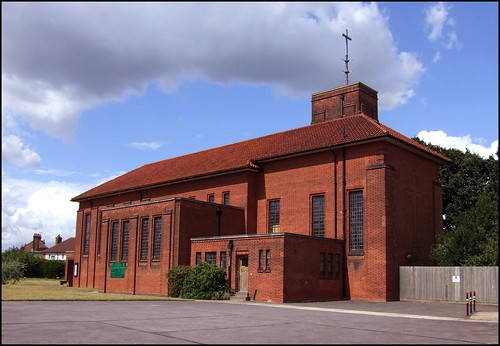
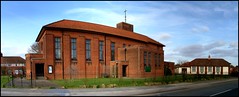
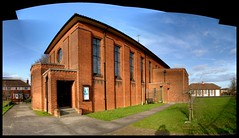
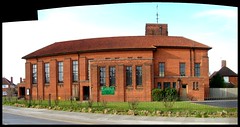
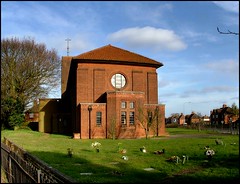
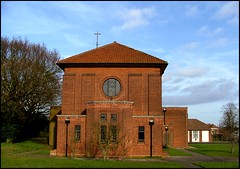
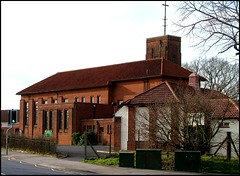
gritty quasi-industrial quality, a
soundness and symmetry about the way
those red bricks build to their big-boned
roof, with bold angles and geometric
juxtapositions. It might be a small
cathedral, almost. It is no coincidence
that both Gilbert Scott and Cautley were
medievalists at heart. The
parish of All Hallows is one of the
poorest in East Anglia. It is one of just
four places in Suffolk designated as a
Social Priority Area by the European
Community Social Fund. But almost the
very first thing that Rick Tobin, the
current Vicar, says to me when I meet him
at the church is that "It's a lovely
parish. Such a lovely parish." Here
we are in the heart of the low-rise 1920s
Gainsborough Estate. My house is barely
half a mile from All Hallows, but the
difference between where I live in the
leafy avenues around Holywells Park and
here is jaw-dropping. These are not
streets that I would want to walk alone
at night. But Rick Tobin does just that,
and is known and loved by the people of
the estate, young and old alike. He is a
saintly, white-haired man, and somehow it
does not surprise me when he tells me of
walking through apparently
confrontational groups of hooded
teenagers, who break out into smiles and
shout "Hello, Vicar!" On one
occasion, the church suffered from a
spate of stone-throwing, with many
windows broken, especially along the
secluded north side. After he had pleaded
for it to stop, several burly, tattooed,
shaven-headed older men approached Rick.
"Don't worry Vicar, we'll find out
who's doing it and deal with it",
they told him. The stone-throwing stopped
shortly afterwards, and has never
recurred.
The great pearl beyond price
which the parish of All Hallows has
retained, but which so many urban
parishes have lost, is that there are
still generations of the same family
living on the estate who have used All
Hallows for their baptisms, marriages and
funerals. It has become a touchstone for
them and their families, and they feel a
sense of ownership of the building.
Gainsborough ward has one of the lowest
levels of higher education qualifications
of anywhere in England, but there is no
doubt that in such a low income,
generally poorly educated and
predominantly white area, the local
parish Church is still valued and treated
with respect by ordinary people in a way
that is fast vanishing elsewhere, despite
the fact that many of those people may
rarely enter it. This is a happy
circumstance for a church building of any
kind, which needs to feel the life of the
community around it. It is also, of
course, a deep irony.
I think that All Hallows is
one of the most significant 1930s
buildings in Suffolk. There are a few
which are more important, most notably,
perhaps, the Royal Hospital School at
Holbrook, and perhaps the Gaumont (now
Regent) Theatre in Ipswich. But All
Hallows is all of a piece, and its
contents still largely in their original
integrity, making this the finest
complete document of the Art Deco
movement in Suffolk. The cruciform
building has an interesting shape, which
suggests surprises inside. This
impression is rewarded as you step
through the doors. This is no mere hall.
Instead, there is a lovely interior with
a devotional atmosphere. The dimness
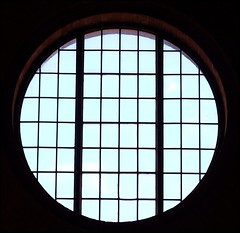
inside is pierced by high windows,
amplifying the sense of the numinous.
Cautley intended the people to use the
double entrance either side of the west
end, which opens onto a large space where
the two streets divide. This is now a
garden of remembrance. You can also enter
by way of a sheltered porch on the north
side of the building, into the north transept,
which was at one time designated the
'Boys Brigade' chapel, but has been
reordered to provide a space for young
children to be together during the
services. The fact that this places them
closer to the nave altar
than the rest of the congregation tells
you something about the sacramental
priorities of this worshipping community.
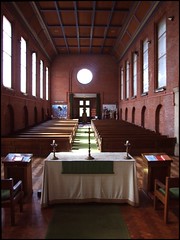
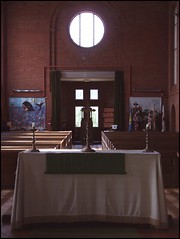
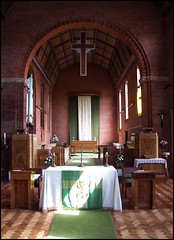
There are two altars.
The nave altar is set in the crossing,
and is the only modern intrusion into the
space. It has been designed to fit in
perfectly, although when the space is
empty you sense Cautley's intention to
create a pivotal area of Cathedral-like
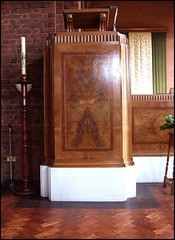
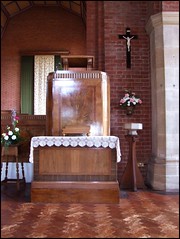
intensity. Behind are the marvellous
matching Art Deco pulpit
and lectern,
like bakelite radios waiting for their
dials to be fitted. Everything is inlaid
walnut veneer, original features
completely in keeping with the building.
Beyond these are Cautley's choir stalls,
still in use for their original purpose.
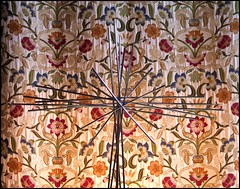
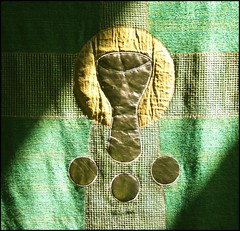
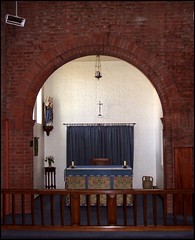
The high altar is a shrine, beautiful in
its simplicity. A narrow hanging offsets
an exploding steel cross set on the altar
itself. There is no frontal, just more of
the walnut veneer familiar from the
crossing.
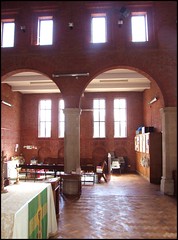
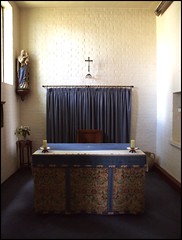
The south transept opposite
the entrance is perhaps the most
beautiful part of the church. It is the
Lady Chapel, curtained off from the
crossing, and the only part not entirely
Cautley's work; it was refurnished in
1951. Here, in functional brick with
narrow lancet windows, so that there is
the impression of being in an underground
crypt, there is a beautiful devotional
atmosphere. The sanctuary
echoes the medieval integrity of the
churches Cautley knew so well, with a piscina
and aumbry
picked out in brick.
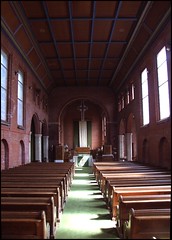
To the west of the church,
the nave is the only one in Suffolk with
a cinema rake, the back pews about a
metre higher than those at the front, the
sight-lines focused on the high altar. I
remember Christine Garrod telling me that
"The slope is very gentle, but we do
have to warn funeral directors".
Beyond the rake, a baptistery is
filled with light; it was reordered in
the late 1990s, and restored to use. The font
and cover are Cautley's design.
The most overwhelming
feeling you get from being inside All
Hallows is a sense of sheer devotion.
Here is something bigger than the world
outside, an uplifting from the mundanity
of material existence. I think it is no
coincidence that each of the main
Anglican parish churches on Ipswich's
large deprived estates - Chantry,
Gainsborough, Whitehouse and Whitton - is
High Church in character.
Rick Tobin asked me if I
would like to go up the tower. Now, I
have a great fear of heights. I have been
told that this is irrational, but I am
not so smug as to think that the laws of
gravity do not apply to me. I'm also sure
that, when my head starts to swim as I
look down, this is my body's way of
telling me to stay away from the edge.
However, as with people who are afraid of
spiders (how ridiculous!) I am always
willing to try a little aversion therapy.
Richard unlocked a narrow doorway, and I
expected to see a flight of steps, but
all that there was inside was electrical
equipment. I waited for him to flick a
few switches and then show me the way to
the stairway, but instead he ushered me
into the cupboard. There, against the
wall, with a clearance from the organ
works of about 18 inches, was a shaft
leading upwards into darkness, a black
iron ladder fixed flush to the wall. My
heart started to flutter with panic, but
having come thus far I began the climb up
into the gloom. I could feel the shaft
pressing against me as I clung on for
dear life. I climbed higher and higher.
Suddenly, I became aware that the space
was opening out behind me. I am not sure
which was worse, the confined space
within the shaft, or the feeling that at
any moment I would be falling backwards
into the darkness. After about twenty
five feet or so, I suppose, I came to the
top of the ladder. I had reached the
level of the internal church roof, and
slightly behind me above my head was a
narrow trapdoor. I now saw with horror
that I would need to let go of the
ladder, reach up to open the trapdoor,
and then lean back into empty
space to climb through the gap. Beyond
the trapdoor, the ladder would continue
within the dark void of the tower space.
At this point, my sense of
self-preservation kicked in, like an
angry dog who wakes to find a
particularly smug cat tucking into his
food bowl. What had I been
thinking of? Shaking, breathless with
anxiety, I carried my sense of vertigo
back down to dear, sweet mother Earth. I
won't be doing that again in a hurry, but
no doubt I shall dream of it regularly
for nights to come. Rick Tobin was very
understanding.
So, how did Cautley come to
design an Art Deco building? Well, he
didn't really. He's using the language of
Art Deco, but he's still thinking
Medieval. Witness the clerestory
above the transepts, the blind arcades in
the nave walls, the brick arches on
creamy columns reminiscent of Polstead.
There is the baptistery,
the transepts
themselves, the Lady chapel. The
Victorian Gothic benches that come from
Ely Cathedral, and the medieval bell from
a disused Norfolk church.
Whichever way you
look at it, this is a delightful,
inspirational building, one which
deserves many more visitors than it gets.
It is also the heart of a vibrant, living
faith community; a power station indeed.
|
|