| |
|
| |
 |
The village of Barking
straggles along the busy B1078, which is
unfortunate. But it is surrounded by
beautiful countryside, with woodland
groves to the east, and surprisingly
steep hills to the west. In common with
several villages around here, it has a
tye. This is a large, open common,
originally intended for grazing sheep and
cattle that were en route to market from
other parts of the country. Shepherds and
cowherds would obviously use local inns
and services, and thus a community would
grow up adjacent to the village. There
are quite a few of these tyes in Suffolk,
and Barking Tye is one of the biggest.
During World War II, it was put under
cultivation for food, and disappeared,
indistinguishable from surrounding
fields. It remained so until the 1960s,
but it is now slowly being returned to
its natural state. This will take time,
and it still looks rather bleak and
barren. But the Parish Council, which
owns the tye, is to be congratulated for
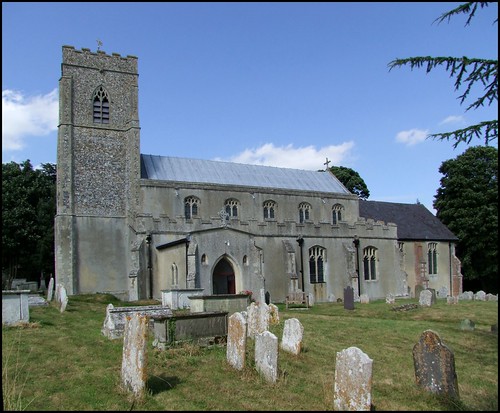
its efforts so far. St
Mary, in common with nearby Combs,
is one of Suffolk's grander churches.
Until the 20th century, it was also one
of the county's more populous parishes,
including as it did the whole of the town
of Needham
Market, where St John the
Baptist church was just a chapel of ease.
All the dead of Needham Market came here
to be buried, conveyed the mile up the
hill on a bier along the Causeway. This
is a journey you can still make today,
albeit under your own steam. Local legend
has it that the word 'causeway' is a
corruption of 'corpseway'.
|
Most
living people will approach the church from the
south, up a narrow footpath between fields. This
steep lane leads you into the very attractive
churchyard, which seems to have been lent an
urban quality by its former association with
Needham Market. The fine Cedars of Lebanon are a
legacy of a 19th century vicar, who was a botany
enthusiast, and collected seeds from around the
world. The journey to the church used to be one
with which you got fairly familiar if you were a
church explorer, since this grand church was kept
locked with a keyholder back down in the village.
I remembered my first visit, pushing my bike the
steep climb up to the church and then having to
come back down again. I'd collected the key from
a nice man who was painting his gate, steeled
myself, and then took on the long climb again.
Today,
this church is open every day, although this does
mean you will miss out on an experience I had
about ten years ago, which I shall tell you about
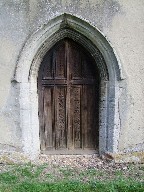
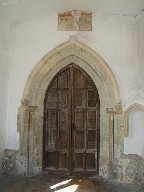
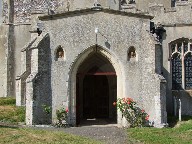
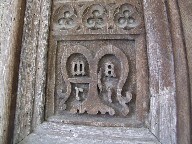
in a moment. The grand south porch protects a
door with some medieval carving, despite a
considerable restoration. There is another one on
the west side of the tower, and a smaller, 19th
century porch on the north side. The tower is in
perfect proportion to the nave and chancel. In fact
it's a bit too perfect; which isn't surprising,
since it was rebuilt in 1870. The grand 15th
century clerestory and 14th
century gargoyles are terrific; and although the
whole thing is cement-rendered, there is still a
very pleasing harmony about it.
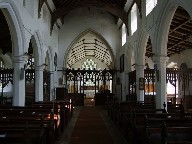
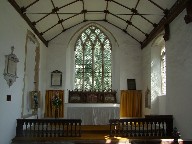
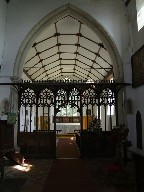
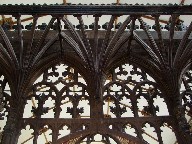
This
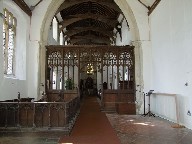
is a huge church, and the eye is drawn eastwards
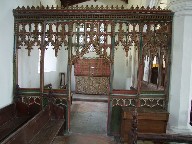
to one of the best screens in the county,
retaining a rare survival, the coving that
supported the roodloft. It is
intricate and beautiful. This on its own would be
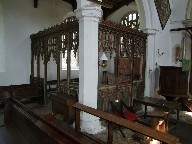
worth coming to see. On either side at the east
end of the north and south aisles are two
gorgeous parclose screens, which
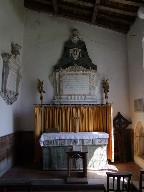
once surrounded chantry chapels. It is a
blessing that altars have now
been returned to them, and the one in the south aisle is
dedicated to the Blessed Virgin, that in the
north to St John; survivals in both chapels point
to an Anglo-catholic enthusiasm early in the 20th
century. The north screen is carved delicately
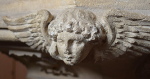
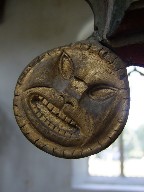
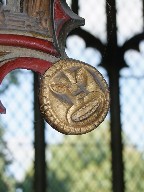
and painted beautifully. The lion pendants may be
familiar to regular users of this site. The south
screen matches it, but without the paint; it is
also heavily restored, after an arson attack in
1974. Standing back from them both, and taking
the roodscreen in as well, you can see that the
rood loft must also have gone over the parclose
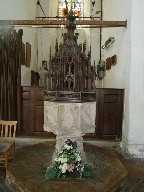
screens, as at Dennington. There are
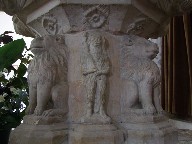
more fine Barking lions around the stem of the
font.
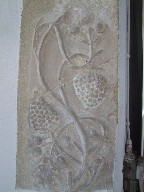
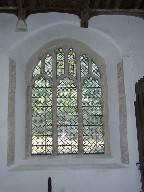
There
is an outstanding quality to the work in this
church. For example, the decorative terracotta
panelling to the window beside the north door,
which would be quite at home in any great urban
church. It depicts vine leaves, flowers and
strawberries, and it was possibly brought here
from the original Shrublands Hall a few miles
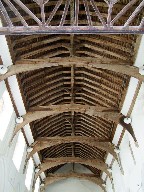
off. There is more at Henley and Barham. The nave
roof is one of the sturdiest of all Suffolk
roofs. It was probably built with oak from nearby
Priestley Wood. Given the proximity of the
wonders of Needham
Market, the people of this parish
certainly knew how to build roofs.
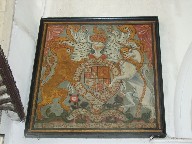
The
restoration Royal Arms proclaim God Save King
Charles the Second, just in case you missed
the point. Stepping into the chancel, through the
magnificent screen, you find a space cleared of
clutter, and the light from the interlocking Ys
of the east window illuminating the stalls set
against the south wall. The tracery on them is
clearly medieval, and matches that on the rood
screen. Given that rood screen and parclose
screen are fully intact, we may presume that this
came from the rood loft itself, in which case it
is another rare survival. All in all, this is a
glorious church which lifts the spirits.
Ten
years ago, however, I was struck briefly by a
different emotion. You will remember that I had
got a key from the village, and I had let myself
into the priest door with it. The door had shut
behind me with a satisfying clunk, and so when I
went to let myself out I inserted the key to open
it again. It wouldn't turn. I tried again.
Gradually, it dawned on me that the key only
worked from the outside, and that the hook beside
the door handle was intended to slip over it to
prevent the latch from going home. I had not
spotted this, and consequently I was locked in.
Well,
I didn't panic. If the worst came to the worst, I
had my trusty mobile phone. I checked the screen
to make sure there was a signal. There was no
signal. Rather more frantically, I went and
looked for another way out, and discovered that I
could unhitch, unlatch and unbolt the Fort
Knox-like structure of the south doors. It was
like a massive jigsaw puzzle. At last, I saw
daylight! I went round to the priest's door, let
myself back in again, carefully hooked the door
handle, rehitched, relatched and rebolted Fort
Knox, and stepped back out the priest's door,
which closed with another satisfying clunk.
I
took the key back to the bungalow at the bottom
of the hill. The nice man was still painting his
gate. "Thanks very much, it's a smashing
church", I said.
"Good",
he replied. "Glad you enjoyed it."
| I went to get on my bike,
but then turned back to him. "By the
way, I manged to lock myself
inside", I confessed. He
laughed. "Oh, everyone does
that", he said, and cheerily waved
me off.
As I pedalled onwards, it
occured to me to wonder what would happen
to people who didn't manage to escape
through the south porch. Presumably he
would go and let them out, if they hadn't
returned the key after an hour or so. And
then I thought that it made rather a good
metaphor, a church that was easy to get
into and hard to get out of, and you
could construct a good sermon around it.
And then I thought, the next time a
churchwarden complains about the
declining congregation of their church, I
shall suggest they fit a door like this.
|
|
 |
|
|
|