| |
|
 |
|
When I
first visited this church and wrote about
it in 2002, I observed that it was a
great tribute to County Council planning
policy that this little church can seem
so lonely and isolated, despite the fact
that the thirty thousand houses of the
housing estates of south-west Ipswich are
barely a mile away, and the great A12
rift valley lies half a mile to the west.
Here, in high summer, the birds boil out
of this glorious sanctuary of a
churchyard, and in winter you could be in
any century. Part of its remoteness is
because the village itself is a good half
mile away, and there can't be many places
so close to Ipswich that it is still
possible to spend an hour without seeing
another human being. What I hadn't
foreseen when I visited last was that
this was a church community in its last
days, pretty much. Congregations had
fallen into single figures, and urgent
repairs were going to cost an impossible
amount of money.
|
In March 2005, I
received a poignant e-mail from a resident of
Belstead, Ken Windsor. Dear Mr Knott, he
began, I live in
Belstead and have just heard that Belstead Church
is to be declared redundant. Sadly this
seems inevitable with a tiny ageing congregation,
although many of us in the village though not
church goers support the church financially and
attend very occasionally. At next
Wednesday’s meeting, I should like, with
your permission, to distribute copies of your web
page for the church because it says so clearly
why Belstead church is important and deserves
support. I have no idea what redundancy
involves but hope that the church will remain
available for christenings, weddings and funerals
with perhaps occasional services, no doubt all
will be revealed on Wednesday.
To put this in
the context of the time, the north Suffolk parish
of Redgrave had just controversially declared its
huge church redundant, in the safe knowledge that
it would be taken on by the Churches Conservation
Trust. Technically speaking, they were very wrong
to do this - the CCT exists to take on redundant
churches that no one else can care for as a last
resort, but it will only take on those which the
Church of England asks it to, and these will only
be those important ones which have already been
declared redundant. Redgrave parish had fiddled
the sytem somewhat, although it would certainly
turn out to be a happy outcome for their church,
and as Ken's e-mail suggested, the event had
generated a frisson of interest among
other parishes facing difficulty.
But redundancy
and the CCT cannot be seen as an easy way of
getting out of repair bills. I told Ken that if
Belstead church was declared redundant, there
were three possible outcomes. If the CCT took the
church on, and this was by no means certain, it
would save the building and enable possible
future use, but under very strict conditions.
Another route would be for a local trust to take
the building on, as at Southolt and Darmsden -
this outcome particularly suits smaller churches
of less historical importance than Belstead, and
enables much more freedom about further use. A
third, terrifying possibility is that the church
would become derelict from neglect, until the
Diocese lost patience and sold the building for
conversion into a private house, as had occured
at a dozen or so churches in Suffolk.
Well, as so
often happens, the sheer threat of losing their
church galvanised the people of Belstead. Great
local interest was generated, and the flat-lining
heartbeat of the parish church was jump-started
back into life. Because of so many people getting
involved, the church was not declared redundant.
I suspect that having someone like Ken among them
helped. The amount required for repairs turned
out to have been over-estimated, and work parties
set to clearing the graveyard of overgrowth and
cleaning out the inside of the church. In October
2006, Ken could report to me that the village rallied,
and we have been able to reverse the decline and
run monthly services that attract around 30
– up to 50 on high days and holidays.
It’s an encouraging start. It was with
delight that I now noted that Ken, this energetic
catalyst who had told me that many of us in the village though
not church goers support the church, was
now, in fact, the churchwarden!
I
came here again in the hit-and-miss summer of
2008. It was a pleasant enough day, and I was
nearing the end of a tour of the Shotley
Peninsula. I decided to call in at Belstead
church on my way back into Ipswich, and cycled
out of the village on the road towards Copdock.
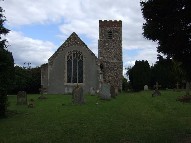
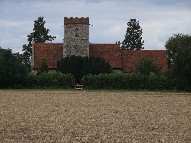
Soon, the pretty and familiar red brick-topped
tower rose above the barley fields. I turned the
corner, and hauled my bike off up the verge. The
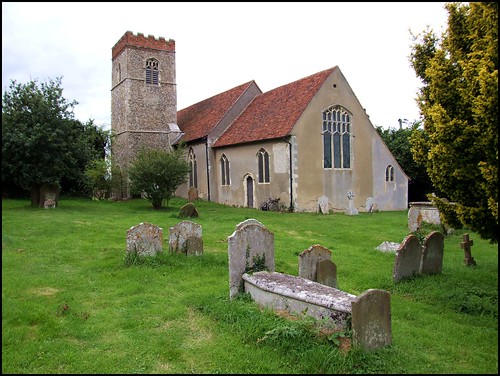
view from the road is lovely. As many do around
here, St Mary has a tower to the south of the
nave, and the porch is beneath it. While I was
contemplating it, I heard a large vehicle brake
sharply behind me. I turned to see a smiling man
get out of a hastily parked van. If this was a
novel, it would seem most unrealistic to tell you
that it was my erstwhile correspondent Ken
Windsor, but in fact this is exactly who it
turned out to be. He was excited that I had come
back to Belstead, and I was pleased to meet this
man who had led the salvation of the building,
and so we briefly formed a mutual admiration
society before he led me up the path and into the
church.
In
2002 I had described stepping into a
gorgeously unkempt interior; the decorators have
been kept at bay here for many a long year, and
the smell of damp is the same one that our
ancestors experienced. On reflection, this
vicarious enjoyment of neglect seems rather
unfortunate, and so it is with pleasure that I
can report the church now feels thoroughly loved,
looked after and cared for. St Mary is one of the
most interesting of all the outer-suburban
Ipswich churches, simply because it has more
medieval and early-modern survivals than any
other. Pride of place goes to the roodscreen
dado, despite the fact that it is terribly badly
mutilated. William
Dowsing
came here on January 29th, 1644. It was a Monday
morning, and Dowsing was setting to work that day
on the Ipswich churches. He had already visited Chattisham, Copdock and Washbrook that morning, and this day
would see visits to a record eleven churches. He
found much to do at Copdock and Washbrook, and
didn't skimp here either, finding idolatrous
images in stained glass, and brass inscriptions
to melt down. The rood screen doesn't seem to
have caught his attention - but then, none in all
Suffolk did. Perhaps it was painted over, or
maybe the vicious scratching out of the faces by
the Anglicans a century earlier seemed enough
hatred to unleash.
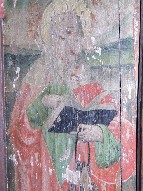 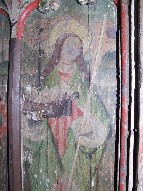 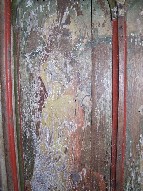
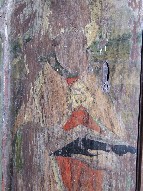 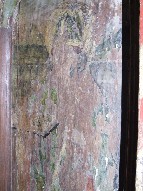 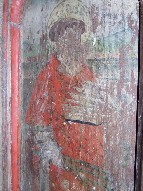
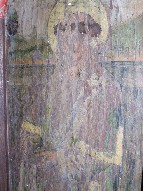 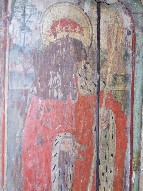 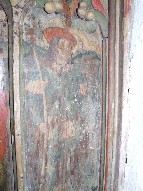
The
panel figures are arranged so that female Saints
are on the north side, and male Saints on the
south side. Several panels are almost completely
obscured as a result of the Anglican vandalism of
the 1540s, but they include St Sitha with her
bunch of keys, St Ursula holding a ship and an
arrow, a female figure who is probably St
Margaret, two Bishops, St Lawrence with his grid
iron, St Stephen holding stones, St Edmund in
royal robes with an arrow and St Hubert with his
bow - I had previously identified this last
figure as St Sebastian, but I am pretty sure now
that it is St Hubert. Interestingly, three of
these figures are shown holding arrows.
Just
to the south of the screen is a fine-looking old
piscina in the south wall of the nave. It looks
as if it is melting, and it probably served an
altar which was here before the rood screen was
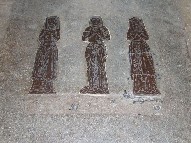
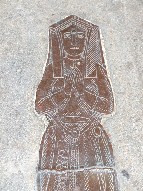
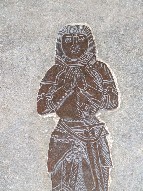
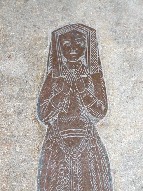
built. The only surviving brass (because of
Dowsing, we know that there were once others)
lies in front of the screen. Back in 2002, it was
covered in perspex, obstensibly to protect it,
but of course the damp was collecting beneath it.
Now, it is free and able to breathe, and is very
beautiful. It is to John Goldingham and his two
wives (not at the same time, silly) and dates
from about 1520, the eve of the Reformation. It
is a fine survival, and deserves to be better
known.
The
north aisle is a curiosity, because although the
windows in it have medieval tracery, the arcade
which separates it from nave and chancel is
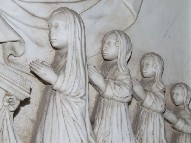
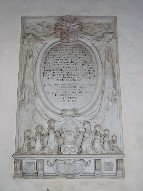
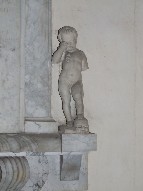
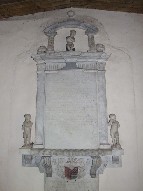
clearly Victorian. The north chancel chapel is a
delight, home to a some gorgeously sentimental
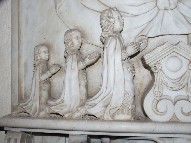
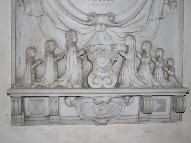
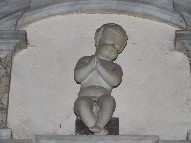
17th century memorials. The best is by John
Stone, and it is to Elizabeth Blosse. She died
during the Commonwealth, and the tablet shows her
three sons, and four daughters, kneeling in
puritan piety over a prayer desk. It goes some
way to compensate for the smashed stained glass
and melted-down brasses which she was no doubt
partly responsible for. Other memorials are to
Tobias Blosse, her father-in-law, and some
austere memorials of a century later. I had found
this aisle full of clutter six years previously,
but the enthusiastic parishioners of Belstead had
worked hard to bring it back to order.
There
is a modern yet rustic roof to the nave,
constructed by a local firm in the 1930s. Roy
Tricker notes in the church guide that the great
Munro Cautley, at that time Diocesan architect,
submitted an ambitious plan for a double hammer
beam roof, and then went off in a huff when his
plans were rejected.
| It was all very pleasing, to
come back to this church and find it such
a success story. I looked around for the
visitors book, but couldn't find it. Ken
thought for a moment, and then remembered
seeing one on a shelf in the vestry. He
went and got it, a thick, hard-backed
volume bound in green cloth, with those
swirly patterns on the end papers. We
leafed back through it, looking at
entries going back into the 1920s. It was
poignant to read the messages written in
at the end of the Second World War. The
last entry in the book had been long ago,
back in 1961, a few weeks after I'd been
born. It felt a kind of honour to add
mine underneath it. And then, back on my
bike, over the great rift valley to
Copdock, a few minutes away.
|
|
 |
|
|
|