| |
|
 |
|
The Essex and Suffolk
borderlands are home to East Anglia's
loveliest landscapes, albeit mostly on
the Essex side, and the loveliest
villages, on both sides of the border.
Much is made of Finchingfield and Castle
Hedingham a few miles across the Stour,
but I prefer Clare. It is a proper
old-fashioned English village, a little
town really, and always seems busy. Its
attractive buildings, pubs, shops and
setting on the busy Sudbury to Haverhill
road mean that it has become something of
a martyr to traffic, but it does feel as
if life goes on here. The
traffic is also a consequence of the
short-sighted decision to close the
Colchester to Cambridge railway line in
the 1960s. Clare used to have a busy
railway station, built slap in the middle
of the castle precincts by enthusiastic
Victorians. John Appleby remembered it
fondly in his splendid A Suffolk
Summer, written just after the War.
As I say, the railway has gone now, but
you can still visit the station. The
castle mound is little more than it
sounds, but Clare has a long and
turbulent history.
|
St
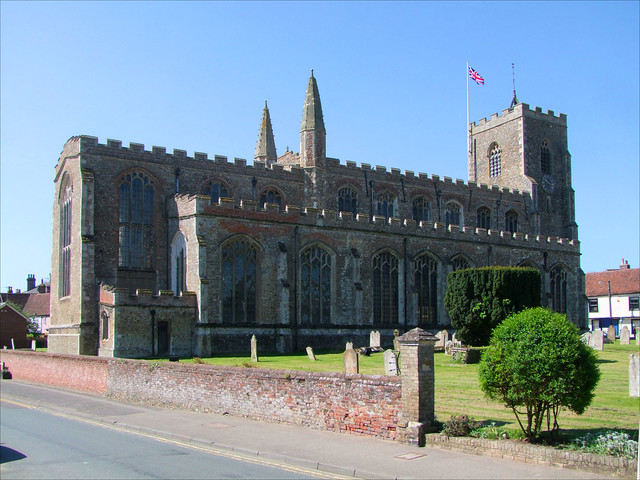
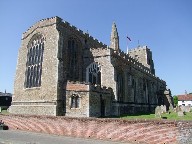
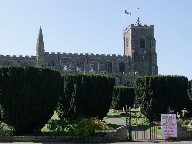
Peter and St Paul is a big church, and
if it does not stand in the first rank of Suffolk
churches it is because history has been so
vigorously rewritten within its walls, that it is
hard to see it as anything other than the rather
pleasant Church of England parish church that it
has become. Externally, however, it is as grand
as any. It sits to the north of the little
square, and is surrounded on three sides by
roads, giving it a suitably urban feel. Much of
it has been rebuilt over the years; most of the chancel in 1617,
most of the nave in the 1440s, the tower at
the end of the 19th century, mainly with the old
materials. Other survivals from medieval times
include the base of the tower, the aisles, the
south chapel-cum-porch, part of the east window,
and the lovely rood stair turrets either
side of the east end of the nave. There is
something similar at Lavenham, and you
can see them on a smaller scale at nearby Stansfield; but the
ones here have little spires on them.
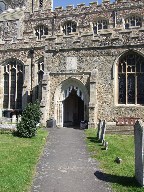
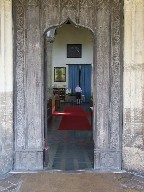
You
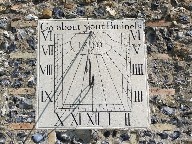
enter through a little porch set into the south
aisle. Above it, the 18th century sundial says Go
about your business. However, this should
not be taken as a rebuff. It refers to the parish
business normally undertaken in the porch, and
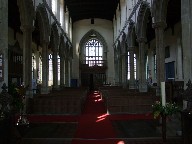
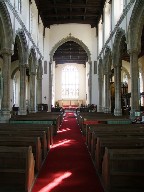
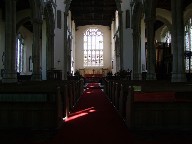
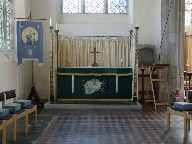
the church itself is always open every day. You
step into a cool, light space, the thrust of the
arcaes pushing the roof space up and making the
church seem higher than it is, a neat trick. The
east and west windows, although containing
coloured glass, allow light to sweep the nave.
The east window is wide and flattened, an unusual
survival of the early 17th century, when the Laudians were
making their ill-fated attempt to restore the
liturgical integrity of English parish churches
by repairing the chancel and restoring it to use
after half a century or more of neglect.
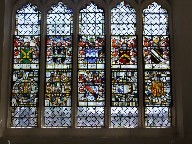
The
window containing glass heraldic shields of the
families who paid for the rebuilding is worth a
glance, since it contains scatterings of medieval
glass collected after the destruction of January
6th 1644, of which more in a minute. The
unusually high chancel arch is rebuilt, but must
have contained a very high rood, given the
extreme height of the upper roodloft stairway
entrance. The church is light because, famously,
the puritan iconoclast William Dowsing went on
one of his greatest wrecking sprees here. He
claims to have destroyed 1000 images in
stained glass. Clearly, as Dr John Blatchly
points out in his commentary to the latest
edition of Dowsing's Journal, this is not
possible, and the true figure is probably nearer
185, and certainly no more than 200. Perhaps what
Dowsing is trying to tell us is that he arrived
to find the church filled with coloured glass,
and destroyed the lot. In fact, a few panels
survived, including the sun and moon specifically
mentioned by Dowsing.
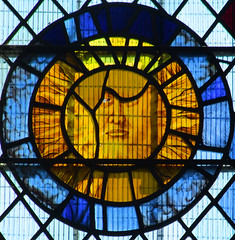 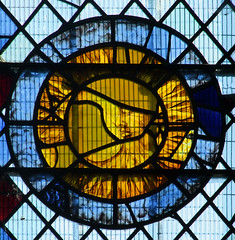
They
are extraordinary survivals, on a scale unknown
elsewhere in East Anglia, and the heart breaks to
wonder what the accompanying crucifixion must
have been like. Perhaps they were rescued from
the floor by someone, and replaced in a later,
more sympathetic age; although, as late as the
1870s, the Reverend White, in his introduction to
his edition of the journal, congratulates Dowsing
for destroying pagan imagery, and also for
destroying images of the Holy Trinity. Actually
Dowsing was rather careless here, since John
Blatchly and Mortlock report
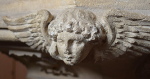
that he missed the head in the porch and Marian
monograms elsewhere.
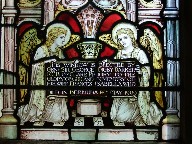
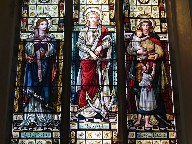
Inevitably
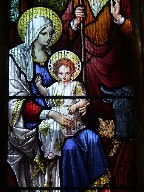
in a church of this scale, the quality of the
later glass is variable. The Ward & Hughes
and Powell & Sons workshops are not at their
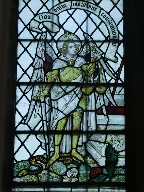
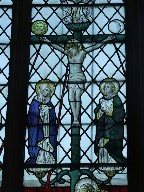
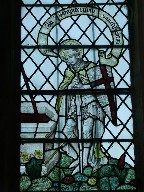
best here, but there is an excellent window in
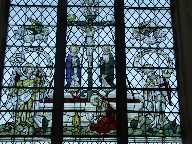
the north aisle by FC Eden depicting the
crucifixion flanked by St John and the Blessed
Virgin, the whole piece flanked by St Michael and
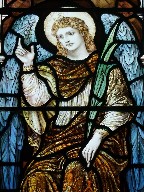
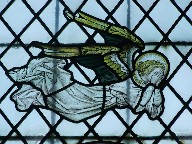
St George. Splendid angels weep in grief on
either side of the cross, and the sun and the
moon familiar from the east window are replicated
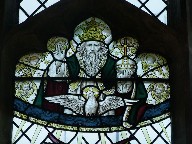
here. In the highest light sits God the Father
with the dove of the Holy Spirit, creating a
Trinity group with the crucified Son below. I
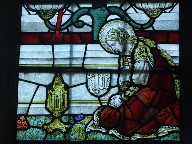
wonder what Dowsing would have made of that. Mary
Magdalene kneels at the foot of the cross.
Perhaps Eden was interpreting what might once
have been in the east window.
The
high side chapel extends southwards from the
south aisle, a part of the same structure as the
porch. It was probably a chantry chapel for the gild of St John the Baptist. In
more recent times, it was converted to the needs
of the preaching-house the church had become, by
the addition of a gallery. Other features of
interest to the church visitor include the
remains of a parclose screen to a
chantry chapel in the south aisle, a beer jug
similar to the ones at Hadleigh and Hinderclay, and a
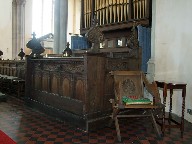
surviving section of the roodscreen in front of
the organ. There a fine brass eagle lectern, so
beloved of, and copied by, the Victorians.
There's another one at nearby Cavendish.
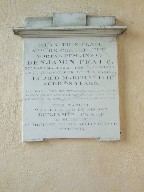
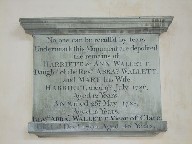
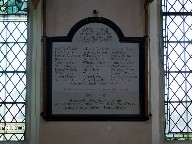
| As in any large village
which knew prosperity in the 18th and
19th Centuries, there are a number of
interesting memorials to the rising
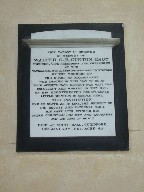
middle classes. Walter Gunton was the
Founder, Vice-President and Treasurer of
the Commercial Travellers' Benevolent
Institution. Further along the wall,
Benjamin Pratt was master of the free
school and vestry clerk of this parish.
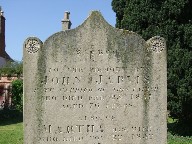
Outside in the neat
churchyard, which is sliced in two by the
length of the church so that you have to
go out onto the road or through the
church to get from one part to the other,
John Jarvis was late carrier of this
parish, hardly a recommendation to
business one would have thought. At the
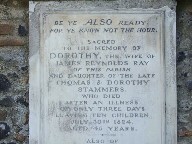
foot of the tower is Dorothy Reynolds
Ray, who died in 1824 after an
illness of only three days, leaving ten
children. She was 45 years old. As
if this were not bleak testament enough,
her memorial reminds us Be ye ALSO
ready, for ye know not the hour.
|
|
 |
|
|
|