St Peter, Claydon

www.suffolkchurches.co.uk - a journey through the churches of Suffolk
|
St Peter, Claydon |
|
|
||
www.suffolkchurches.co.uk - a journey through the churches of Suffolk |
||


Follow these journeys as they happen at Last Of England Twitter.
| Claydon is a large village on the
northern outskirts of Ipswich. Its medieval parish church
was declared redundant in 1977 at a time when a number of
churches were being closed by the Diocese of St
Edmundsbury and Ipswich with a speculative view to a
sale. It was rightly assumed that planning permission for
conversion to domestic use would be easily obtained by
purchasers, but in the event these sales often failed to
materialise. No one stepped forward to buy Claydon
church, but the diocese refused to allow local trusts or
charities to take it on for no financial return. Sam
Mortlock quotes from the Redundant Churches Fund report
for 1987: Within sight of new housing and burgeoning
prosperity the diocese left this historic church to rot
for eleven years while attempts to find an alternative
use came to nothing. It is one of the most conspicuous
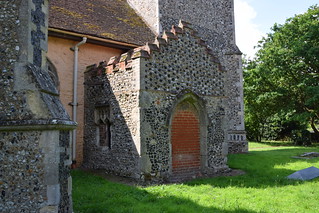
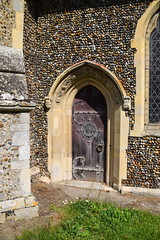
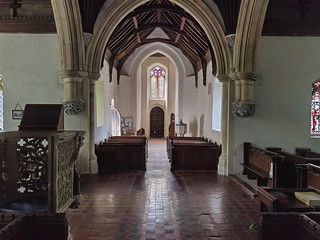
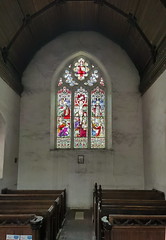
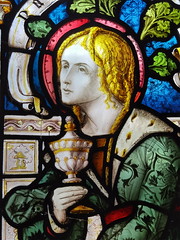
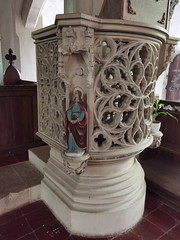
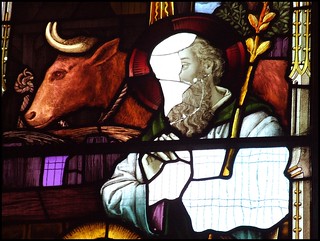
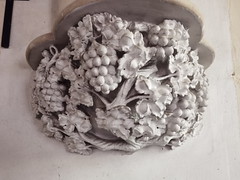
cases of neglect we have come across. In the end, perhaps it was the bad publicity that shamed the diocese into allowing the church to be vested in the care of the Churches Conservation Trust. Today, the building is beautifully cared for by local people, but eleven years of abandonment inevitably took their toll. Incidentally, it may seem extraordinary that the parish church for a large village of more than four thousand people should be declared redundant, but there is a larger medieval church in Barham, with which Claydon forms a joint village. Barham church also has a much larger burial ground, and perhaps in any case it was considered less saleable than Claydon church. Unless you are an enthusiast of Anglo-Catholic history, Claydon church is one of the great forgotten 19th Century rebuildings. In style and substance it looks the work of an amateur Pugin, which is pretty much the truth. The rector for most of the second half of the 19th Century was Father George Drury, one of the great High Church eccentrics. So often in East Anglia we see the fruits of Anglo-Catholicism in its early 20th Century ascendancy, as at Kettlebaston and Lound. Here at Claydon we see evidence of a movement besieged in the struggles of half a century earlier. Drury suffered attacks on his person, property and reputation. The convent he established here in Claydon was broken into by a mob, who 'rescued' a nun and carted her off to a lunatic asylum, where she was incarcerated under the orders of her father. She stayed there until her father died. Drury's rectory suffered so many assaults that eventually he built a nine-foot wall around it, which you can still see today to the east of the church. Anti-Catholic slogans soon appeared on it. It has to be said that 'Firm Father George' rose to the challenge with enthusiasm and probably with a certain amount of enjoyment. In the 1870s, half a century before such things became generally acceptable in the Church of England, his congregation had paraded through Claydon with banners of the Blessed Virgin flying, kneeling down with them in a field while singing the Ave Maria. High Mass at Claydon church was accompanied by incense, vestments and candles. The local protestants were scandalised beyond belief, and were inevitably supported by popular opinion and the Low Church Bishop of Norwich, in whose diocese Claydon was at the time. They hatched plot after plot against him. The most famous of these was the Akenham burial case, which led to a change in national burial laws. You can read about it on the page for Akenham. The major rebuilding here was by that worthy enthusiast Richard Phipson, the diocesan surveyor. But it was carried out under Drury's direction, for the Drury family also presented to the living. This was not unusual of course, for many landed families held the patronage of their local church, and often presented a younger son to it. But by the second half of the 19th Century this was becoming less common, for younger sons often preferred the opportunities for advancement out in the Empire. It survived only where the family embraced evangelical or Tractarian ideals. For them, the nature of the priesthood had a somewhat higher status. Phipson built a tall pair of transepts across the western half of the former chancel, leaving a cruciform church with a small chancel. Although this is demonstrably the work of Victorians, there are a number of earlier survivals visible externally, including long and short work at the two western corners of the nave. This is usually indicative of Saxon work, although it is difficult to say how much of this is genuine, and how much Drury and Phipson's sleight of hand. You step into an interior which is at first a bit gloomy and more intimate than the sprawling exterior might have led you to expect. The font facing the south door is a 15th Century piece with crowns and angels. The nave is narrow and opens up quickly into the crossing, the transept on each side equally the length of the nave. Everything is focused on the small, colourful chancel beyond the crossing. Much of the interior furnishing was the work of Drury himself, for his secular passion was carving in wood and stone. The pulpit is his, as are a number of the little details on roofs and walls. The pulpit is an extraordinary thing, a bubbling, lacy extravaganza, with niches to the two front corners. These are currently filled with early 20th Century images of St John and the Blessed Virgin, presumably reused from a rood group, although whether Drury himself ever filled the niches with anything is unclear.Much of the interior carving is by the great Ipswich woodcarver Henry Ringham under Drury's direction. The marble mensa stone with its consecration crosses was brought here from the similarly early ritualist church at Shipmeadow near Bungay, which had been declared redundant a few years before Claydon church. Altogether this work was an extremely early ritualist makeover, dating from the 1850s. Newman had crossed the Tiber barely five years before, and the Sanctus, Sanctus, Sanctus of the reredos must have caused a few racing pulses. The interior is an extraordinary memorial to Drury. Perhaps most memorable of all are the naive, charming roundels he designed for the east window of 1851.
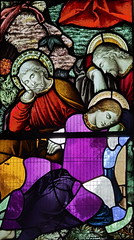
The interior suffered greatly during the years of abandonment. Of Henry Ringham's four large evangelist symbol bench ends under the crossing only St Mark survives. The stained glass, especially that in the transepts by Albert Moore, is still peppered with holes from stones thrown by the descendants of those who had stoned Drury himself a century before. The glass has been carefully restored with clear panels to replace the missing ones, perhaps as a reminder of the consequences of neglect. The church today is rather a sad
place. The care of local people and the Churches
Conservation Trust is clear to see, and yet this can't
overcome a feeling that this is a place whose time is
past. No congregation will ever file back in here for
High Mass. Clouds of incense will never again billow
around six candles burning on the altar. Drury's rood
screen succumbed to the vandals. The splendid war
memorial depicting the Madonna and Child by Henry Moore
which was given to Claydon church in 1948 was removed in
1978 under Moore's direction and can now to be found at
the other end of the joint villages in Barham church. Drury's funeral in 1895 was
carefully documented by 'ritualism-watchers', who noted
the robed choir, the cross carried in procession, the
incense and the sign of the cross. Drury would have been
amazed that his position in the Church of England would
have become fairly mainstream by the 1920s. Less so,
perhaps, by its rapid retreat in the years since. His
large grave is guarded by railings in the south-east
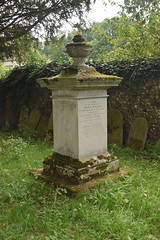
corner of the churchyard, beneath the great yew. For one
moment there, you can forget the churchyard's surrounding
suburbia of bungalows and semi-detacheds, the modern High
School across the road, the new housing estate. Here, the
19th Century still exists for a moment. |
Simon Knott, August 2020
Follow these journeys as they happen at Last Of England Twitter.













|
||||||||||||||||||||||||||||||||||||||||||||||||||||||