| |
|
 |
|
Hawkedon is one of the
strangest places in Suffolk. There's
nowhere else quite like it. Here, in the
rolling landscape between Haverhill and
Bury, is where the Chiltern Hills come to
die. On their journey through
Bedfordshire and Essex they become lower
and softer, with occasional last stabs at
glory before sinking beneath the Suffolk
heathlands. Rede,
the next parish to Hawkedon, is the
highest point in East Anglia. You
can climb up into Hawkedon from
neighbouring Hartest
and Stansfield,
and when you do you find a few ancient
houses and a pub scattered about a wide
village green that forms the highest
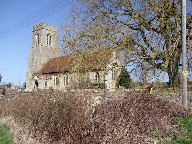
point in the parish. And right in the
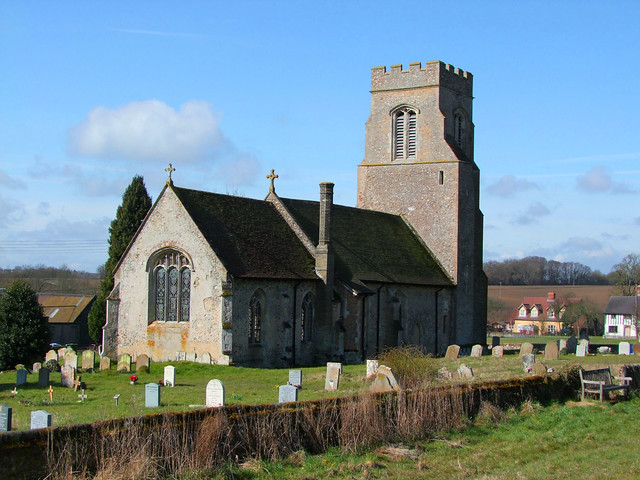
middle of the green is St Mary. Its
walled churchyard is surrounded by the
green on all four sides, and it is the
only church in Suffolk where this is so.
One of the finest sights the county has
to offer is on a summer's evening,
approaching the green from Hartest, and
watching the sun sink low behind St
Mary's tower.
The building itself is a
fairly typical rural west Suffolk church.
Take away the 14th century tower, and all
you have is a simple Norman church
augmented by a chancel and elaborated
with later windows; but there are no
aisles, no clerestory. The windows, and
the delicious south porch, are a reminder
that this was the wealthiest and most
populous part of England in the 15th
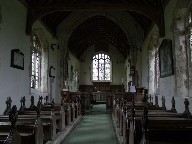
century. It is an intimate space that you
let yourself into, full of surprises.
|
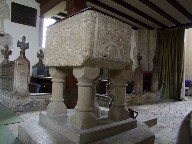
Beneath
a beautiful, curved early 20th century gallery,
what is probably the original Norman font is one of
Suffolk's best. It is also rather unusual, being
unsymmetrical. It may be that it was once square,
and has had two corners sawn off. I don't think
it was designed to be an irregular hexagon in
plan. On it are carved primitive designs that
might represent a sheep's horns. four of the five
supporting pillars have been replaced, but the
most easterly is original. It must have been very
dramatic before restoration.
Now
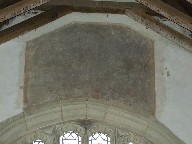
lost to us unfortunately is the St Christopher
wallpainting that the Victorians uncovered; it
has almost completely faded, and mere glimpses of
it can be seen beside the hatchment that now
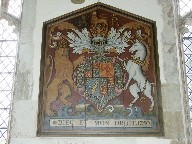
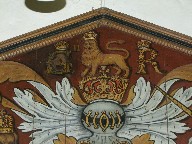
hangs there. Opposite, there is a vast royal arms
on the north wall. The artist seems very keen to
have asserted the masculinity of the two
supporters. Interestingly, the arms themselves
are Stuart - but this claims to be from 170 years
later, and George II. Clearly, it is a reused set
of Charles II arms, the C cunningly
fashioned into a G. At some point in
between, it appears to have served as the royal
arms of Queen Anne.
Turning
east, there is plenty more to excite and
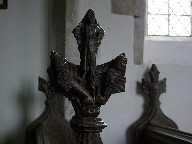
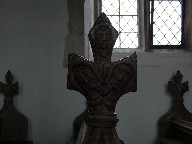
interest. First, there are the bench ends,
similar in shape and scale to those at Withersfield. One shows
a defaced wild man sticking out his tongue while
two griffins beneath salute him. On another are
three bearded oriental men wearing hoods (the
Three Wise Men, perhaps?) and a third shows an
exquisitely carved woman in front of three ears
of corn. The most curious shows two lions
apparently supporting a man who has what appears
to be a thick rope around one of their legs. The
more you look at them and try to interpret their
religious iconography, the more you get the
feeling that these carvings may not, after all,
predate the Reformation. They are almost as if
someone in the 17th century perhaps had wanted to
create beautiful bench ends carvings and had seen
something like these elsewhere. It may well be
that the poppyheads themselves are medieval, but
had been defaced. The oriental gentlemen are very
like the faces on the misericords at Stowlangtoft, and some
of the others could be heraldic. The woman,
however, is a mystery to me - she appears
medieval, but entirely secular.
At
the east end of the nave, the old rood screen has been taken down
to its dado, but part of the sequence of images
survives, although it has been severely battered.
Only one of the figures on the panel is really
recognisable now, and that is St Dorothy with her
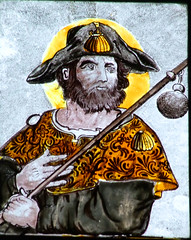
basket of flowers. Another figure with a pilgrim
staff may well be St James the Great.
Stepping
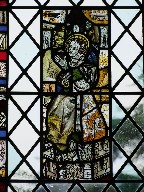
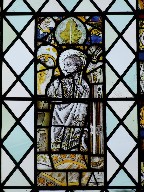
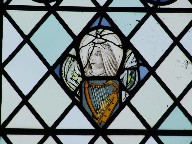
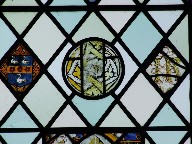
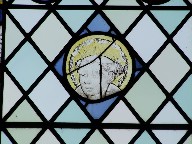
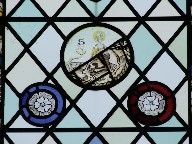
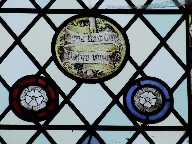
through, the east window contains survivals of
the medieval glass. It is not unusual to find
collections of fragments gathered from elsewhere
like this, but here they are of good quality,
well presented and with some interesting details.
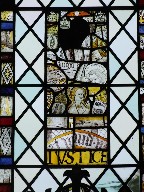
Several heads of saints and kings survive,
including one almost complete figure and another
made up of parts of several, lots of crowns and
even parts of inscriptions. You can make out the
words Virgo and Justice. There
is a wolf, an eagle, a shell of St James, three
ears of corn. The fragments are haunting, and the
sequence must have been stunning in this lonely
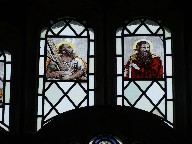
place. Another curiosity is the sequence of
continental Saints in the upper lights of the
east window. They are probably genuine, but they
were copied in the early 19th Century by the
Lowestoft artist Samuel Yarrington, and can be
seen again across the county at Lowestoft St Margaret.
Until the 1930s,
you could still make out a wall painting over the
east window. This is an unusual place, but it was
an unusual subject; it showed the
Transfiguration, a new Catholic Church devotion
right on the eve of the Reformation. The only
other Suffolk representation of it survives at Westhall.
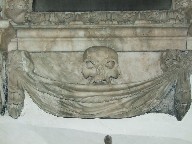
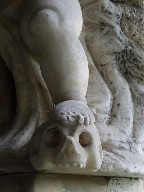
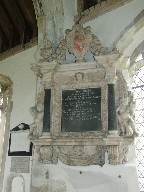
| In the chancel, curious crawling
creatures climb the edges of the choir
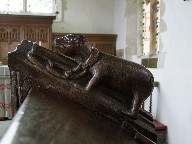
stall desks. A glowering and, Mortlock suggests, entirely
pagan late 17th century memorial is set
at an angle facing south-east. It
includes some vulgar little cherubs. I
came back here in February 2013 with a
friend of mine who works at national
level for a church conservation charity.
He had not heard of Hawkedon before , and
was quite blown away by it, counting it
among the hundred or so best churches he
had visited in England - and, as he has
visited more than ten thousand, that's
saying something. It made me think that
along with Westhall this place is one of
Suffolk's best kept secrets. Like
Westhall, Hawkedon did not make it into
Simon Jenkins' England's Thousand
Best Churches. If that means that
those people who slavishly visit his
choice of churches to the exclusion of
all others miss Hawkedon, then it
probably serves them right.
|
|
 |
|
|
|