| |
|
 |
|
This is a fascinating and
spectacular church, probably the least
visited of Suffolk's great municipal
Perpendicular churches, despite being
only ten miles or so north of Southwold
and Blythburgh,
with which it forms a group. It is one of
the county's biggest churches; and yet,
of the other big medieval ones, only Hadleigh
has suffered a more drastic 19th century
makeover. But there is much of interest
here, and a visit is worthwhile for all
sorts of reasons. Lowestoft's only major
town centre church is the beautiful Our
Lady, Star of the Sea.
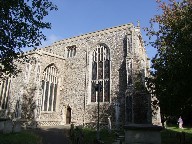
St Margaret stands on a hill top to the
west, which may seem strange, but the
same was true once of the church at Aldeburgh,
although the sea has cut in there to make
the church appear more central. In both
cases, the towers are able to act as a
landmark to ships at sea. All along this
coast, the sea has claimed churches in
the last 600 years; six at Dunwich,
and others at Easton
Bavents, Sizewell, Gedgrave
and so on. At Pakefield,
the church was half a mile from the sea
as recently as 1900; but today, the waves
lap at the foot of its churchyard. In
another 50 years or so, Pakefield
church will be gone, and so will Covehithe.
But not St Margaret. The unpredictable
nature of the tides has meant that the
sea at Lowestoft has actually gone out;
the industrial estate on the Denes below
the High Street was under water 500 years
ago (many would wish it a return to that
state). |
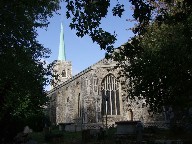
With the town below it, and no major
road leading past it, St Margaret is not a church
to come across by accident. It is surrounded by a
large modern housing estate, but the great size
of the churchyard keeps it at arms length. I have
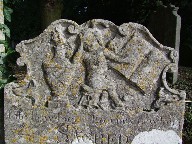
never seen so many gravestones in a churchyard
anywhere else in East Anglia. They cluster and
lean together like a Jewish cemetery.
Like
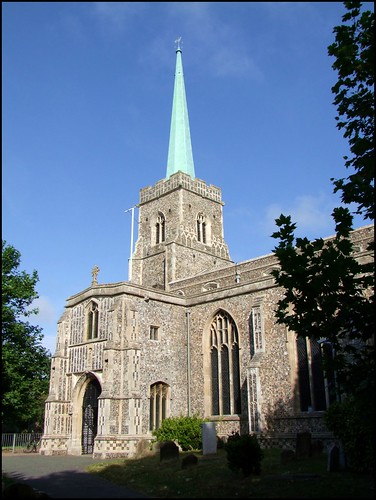
most great Suffolk churches, St Margaret was
rebuilt several times during the Middle Ages. The
14th century gave it a grand tower, but this was
completely dwarfed by the massive nave, aisles and chancel built in
the 15th century. The Reformation intervened
before the tower could be rebuilt to scale, and
so it appears curiously mean beside the body of
the church against it, exactly the same situation
as at Blythburgh, with
which this church has many similarities. The 15th
century builders put an elegant lead and timber
spire on the tower, possibly as a temporary
measure, but it stands there to this day.
| The porch is one of
Suffolk's largest, a double-story affair
as at Blythburgh.
The upper storey may have been an
anchorites' cell, an to this day is
referred to as 'the Maids' Chamber', and
their names are recorded in folklore as
Elizabeth and Katherine. In the vaulting
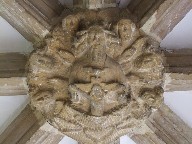
of the lower stage is a magnificent boss
depicting the medieval image of the Holy
Trinity. A seated God the Father golds
his crucified Son while the dove of the
Holy Sp[irit descends from above. A
sign says Welcome - but the door
is ordinarily padlocked, because we are
in Lowestoft, and that is the way the
parishes of Lowestoft keep their
churches. However, the people here are
very happy to open up. If they let you
in, it will be through the Priest's door,
so your first sight of St Margaret will
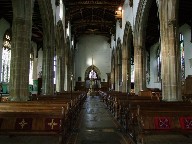
be the huge Victorianised chancel, and
the vastness of the nave opening out
beyond it. There is no chancel arch; as
at Blythburgh
and Needham
Market, this is intended
as a great Perpendicular space.
|
|
 |
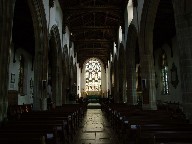
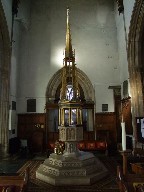
You step down into the wide nave,
filled with turn of the century benches. At the
far west is the gorgeous font cover, the work of Ninian Comper, much more
elegant than his enthusastic work at nearby Lound. Behind it
in the west wall is the rather alarming door to
England's biggest banner stave locker. It is
based on the one at Barnby;
unfortunately, the original is only about 4 feet
high, and this has been made to scale at three
times the size. Given that the Barnby one was
unfinished, is remarkable for its existence
rather than its style, and was hanging upside
down at the time it was copied, it seems a
curious thing to have done.
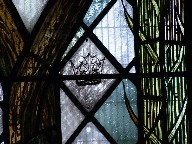
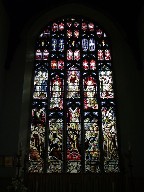
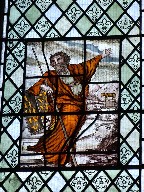
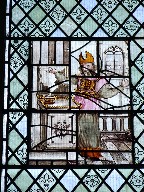
The great east window is filled with
1890s glass, which isn't terrible; but what it
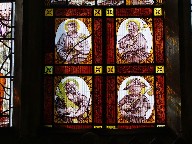
replaced was rather more interesting. In 1819,
the window was filled with glass by the Regency
artist Robert Allen. It is his only known
glasswork, and is terribly rare. Fortunately,
much of it was reset in the south chancel, where
you can see it to this day.It seems curiously
primitive and dated, a fascinating example of
vernacular window painting on the eve of the 19th
century revival. Interspersed with it is a
collection of interesting continental glass,
probably collected and set here by Samuel
Yarrington.
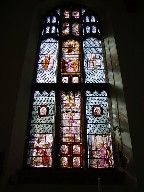 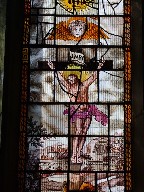 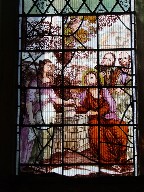 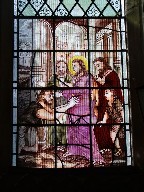
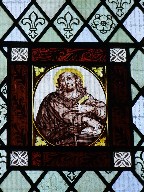
 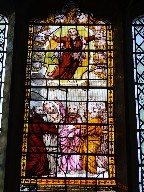 
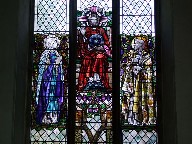
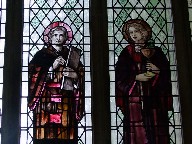
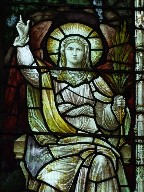
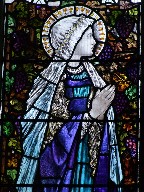
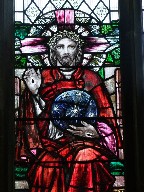
The
gorgeous glass in the west end and north aisle
came from the demolished church of St Peter. It has
lost some of its drama by being moved into such a
large space, but is still excellent. It is by
Christopher Whall.
  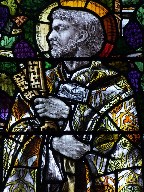
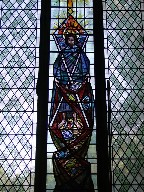
I
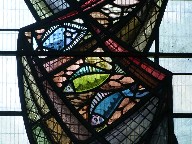
also love the memorial window to Lowestoft's
fishermen drowned at sea; it shows one of their
patrons, St Andrew.
There
are a great many memorials of interest, including
a large number of ledger stones. One of these is
to the 17th century puritan Samuel Pacy, who, as Mortlock reminds
us, was partly responsible for the great witch
hunt hysteria in Suffolk during the 1660s. He
himself accused two local widows, Rose Cullender
and Amy Drury, who were either harmless medicine
women or Catholics, or probably both, of
bewitching his daughters. They were hung at Bury
St Edmunds in 1664, along with 38 other innocent
women and children. It always seems odd to me
that the 19th Century evangelical protestants of
Bury erected a memorial beside St James to the 17
Suffolkers murdered for heresy during the reign
of Mary I in the 1550s, but this equally foulact
by their puritan forbears has been forgotten.
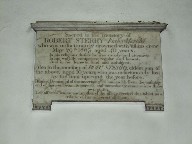
| Another most curious
memorial is on a brass plaque on the
chancel arch; it says To the Glory of
God and in Thanksgiving for the Safe
keeping of the Church and Congregation in
the Violent Thunderstorm of Sunday Aug
21st 1921. The
roof is rebuilt, so we are deprived of
seeing one like that at Blythburgh, which
it probably was once. It has been painted
and guilded, and I wonder if this was
also the work of Comper. The nave is full
of inlays for brasses, most of which,
sadly, have disappeared over the years. A
few remain. The view to the east, with
nothing breaking the roofline until the
east window, is magnificent. There is a
reconstruction of a parclose screen and
loft in the north aisle, which was
intended to continue across the church.
If this had happened, it would have been
a better and more impressive
reconstruction than that at Rattlesden.
Finally, this
church has one of Suffolk's few medieval
brass lecterns; one of the few survivals
here, apart from the font, of the
Catholic life and liturgy of this place
before the Reformation.
|
|
 |
|
|
|