| |
|
 |
|
Before the Reformation,
Lowestoft's Catholic priests ministered
the sacraments at the church of St
Margaret, on a hill to the
west of the modern town. That, of course,
is now in the care of the Church of
England, and the Anglicans also have a
number of other 19th and 20th Century
churches around the town. But there is
only one parish church directly in
Lowestoft town centre, and that is the
Catholic church of Our Lady Star of the
Sea, giving this building a special place
in the urban landscape. It is also the
most easterly Catholic parish church in
the entire British Isles. The dedication, Stella
Maris in Latin, would have been more
common before the Reformation, and it was
probably the original dedication of Ipswich
St Mary at Quay.
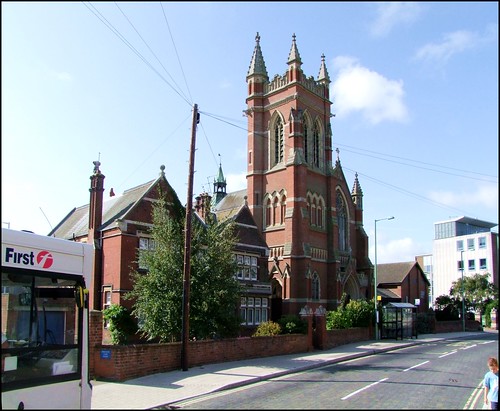
Our Lady is a magnificent early 20th
century essay in Early English cathedral
architecture, and quite the grandest
Catholic church in Suffolk, Beccles
and Bungay
not excepted. Its setting puts me in mind
more of France than England, with the bus
station beside it and its apsed east end
sticking out into the open market of the
Benjamin Britten shopping centre.
|
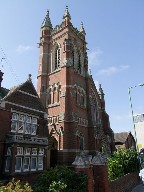
The
red brick and white stone build together, a
sanctus bell turret rises from the spine, to
articulate something rather more sophisticated
than any of the other late 19th and early 20th
Century churches in Lowestoft. The church was the
work of Baines and Richards, and the foundation
stone was laid in August 1900. The parish had
been served by missionary Priests from the Jesuit
community at Great Yarmouth just over the Norfolk
border from about 1850 onwards, and the community
met in an upstairs chapel in the now demolished
Denes area. The first Mass here was on June 5th
1902.
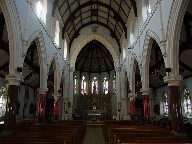
The
western entrance to the nave sits to the right of
the tower. You step into a porch area, and modern
glass doors lead into the body of the church. The
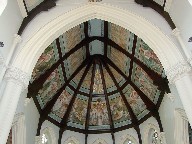
interior is decorated beautifully in a restrained
manner, although, having seen an early postcard
of the interior, I think that the ceiling and
wall murals are probably a little later than the
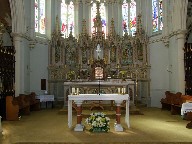
building itself. On entering, all eyes are drawn
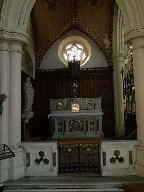
to the sanctuary. With an apse behind, the altar sits in a
central position, with the high altar and reredos beyond it.
Above, a clerestory is filled with Kempe glass,
and above that the apse roof is painted with
Christ in majesty surrounded by the disciples.
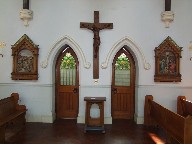
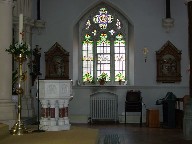
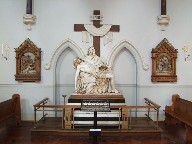
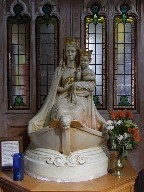
| Around the church are large
carved stations in the Arts and Crafts
manner, and there are other devotional
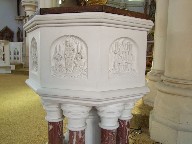
objects, including a modern seven
sacrament font, a pieta, an image of Our
Lady of Boulogne, and a large wooden
cross which may have come from a rood,
although I understand that this church
never had one. The
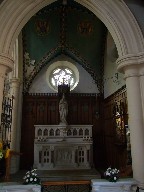
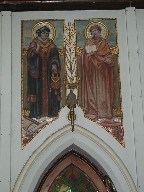
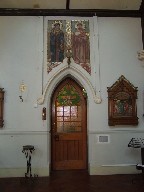
mural paintings of St Thomas More and St
John Fisher are fine, as is the painting
of Mary at the foot of the cross in the
Lady Chapel, where there is also an icon
of Our Lady of Pity. Perhaps most
beautiful of all is the screenwork
between chapels and sanctuary. All
around, on roofs, walls and floor, are
examples of the care and love lavished on
this building over the last century. In
so doing, the people here have imbued it
with a sense of continuity as well.
This beautiful church has a
chapel of ease at Pakefield
St Nicholas,
on the other side of the river, a sign of
the busy life of this parish. Our Lady is
a credit to its parish, and a blessing to
the people of Lowestoft.
|
|
 |
|
|
|