| |
|
 |
|
In the
first few decades of the 19th century,
there was a great enthusiasm for building
cheap, plain churches to supply the needs
of the increasing population in those
areas affected by the Industrial
Revolution. The extent to which
industrialism had touched Suffolk by this
time can be judged by the fact that of
all the hundreds of churches recommended
and approved by the government
commission, only two of them were built
in Suffolk. Both are dedicated to the
Holy Trinity; one is in Ipswich, and the other one
is here in the eastern suburbs of
Stowmarket. Most of the so-called
Commissioners Churches were built in a
style often described as 'Carpenter
Gothic', on a low budget by local
architects and labour. Although they did
not have a uniform plan, most of them
came out broadly similar, with a wide,
boxy nave, a perfunctory chancel, and a
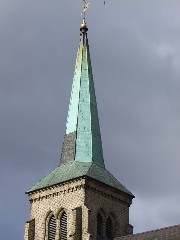
simple tower, often topped by a little
spire. Hundreds were built, and many are
still in use. This one cost a very
reasonable £1500, about £300,000 in
today's money. Much of the cost was
defrayed by the Marquis of Bristol.
|
Dedicated
by the Bishop of Norwich on August 30th 1843,
Holy Trinity was actually quite late for a church
of this kind; far away in Oxford, the Tractarians were beginning to change
the world, with their advocacy of a Church of
England returned to its Catholic roots. Coupled
with the work of the Cambridge Camden Society,
they would turn the Church upside down in the
next twenty years, and the result would be a
succession of expensive and glorious Gothic
temples, carefully tailored to the needs of
sacramentalism. Already at Bury St Edmunds up the
road, another church paid for by the Marquis of
Bristol, St John the Evangelist, was rearing its fantastic
spire into the sky; the turrets cluster below it
in a mixture of Early English and Mad King Ludwig
of Bavaria. Even here, the architect Thomas
Nelson shows the influence of burgeoning
medievalist ideas; his windows have little Early
English points.
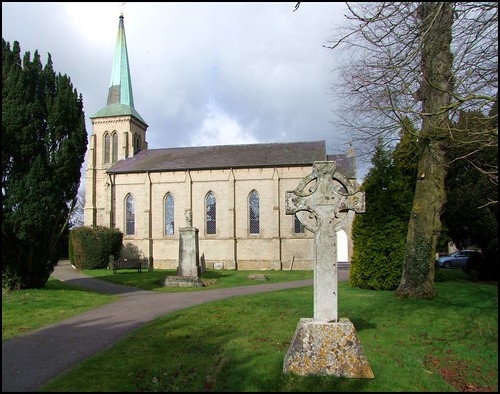
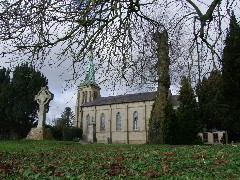
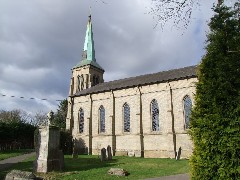
The church sits on
the main road in this busy suburb of Stowmarket,
looking most attractive. The main material is
Woolpit brick, as at Holy Trinity, Ipswich; it has mellowed rather
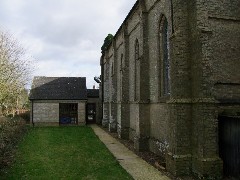
more successfully here. There is a modern
extension to the building to the east, marked
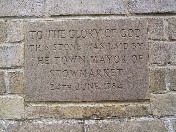
with a plaque unveiled by the Mayor of Stowmarket
in 1984. You enter the church from the west, and
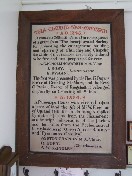
here in the porch is the original foundation
board, beginning This church was erected
1843. It contains 250 sittings,and in consequence
of a grant from "The Incorporated Society
for promoting the enlargement, building and
repairing of Churches and Chapels", the
whole of that number are hereby declared to be
free and unappropriated forever.
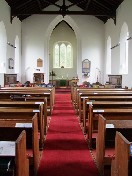
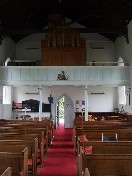
| You step
into a wide, light space under the
western gallery, and to the right is the
recut 15th century font from Creeting All Saints, where the church
was demolished 40 years before this one
was built. It apparently spent the
intervening period as a birdbath at
Ringshall Rectory. The white walls and
red carpets create a sober effect, and
many of the furnishings were replaced in
a more seemly style in the 1930s to the
designs of Munro Cautley, the Diocesan
Architect. The high chancel arch with the
small chancel and east window beyond is
very effective, and it is flanked by two
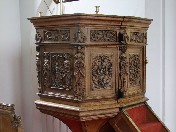
surprises. One is the pulpit, which is
paneled with scenes which must have come
from a huge 17th Century Flemish altar.
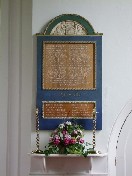
On the other side is the parish war
memorial, designed in the familiar style
of Ellen Rope, whose elegant work can be
found at many Suffolk Anglican and
Catholic churches.
|
|
 |
|
|
|