| |
|
Of all Suffolk,
this is the outback. Here, we are beyond the back
of beyond. North of the Saxmundham to Leiston road, the tiny lanes
thread between the flat fields. I was coming back
here ten years after my first visit to this,
probably the least known of East Anglia's ruined
churches. It was a day in high summer, the
temperature well into the 80s, but it was a
pleasure to spin along the winding roads, with
hardly any traffic to spoil it. I had cycled down
from Halesworth via Dunwich and Aldeburgh, and
all the way the trees had been in fierce full
leaf, the day sodden and drowsy with heat. The
breeze from the sea barely reached a hundred
metres in land, but the churches offered the cool
relief of their interiors, although there would
be no such pleasure here, of course. How very
different to my previous visit! On that late
November day in 2000, the sun had neglected to
rise, and the rains of the previous week were
smoothing the topsoil across the roads as if
attempting to erase them. My bike threw the mud
up, spattering my clothes, face and hair, and it
seemed that I was unlikely to be welcomed at the Friston Chequers in this state. Through the murk, an old
bloke with a dog had appeared over the rise. He
was the colour of the mud. While the dog went
mental, I checked my watch to see if, in my urban
manner, I should wish him a cursory 'morning' or
'afternoon'. But as I got closer, he lifted his
hat and said "How d'ye do there?" and I
realised how far I had come. I was obviously the
first person he had seen for days, and he seemed
agreeably pleased. And, perhaps, a little
relieved, as if he had been entertaining a secret
fear that some disaster had wiped out the rest of
humanity, and he was the only one left. His dog
was certainly unfamiliar with strangers, and
leapt madly around me, rejoicing.
I headed on, and
it began to rain again, as if the sky had come
down to join me. All the colours became one. I
wiped the water from my face, looking for a
footpath marked on the map that headed off
eastwards of here. It would lead me, I hoped, to
the remains of St Peter, Buxlow.
Quite a lot is
known about St Peter. It survived the
Reformation, and Rectors were still being
presented to the living as late as the 1620s.
However, it doesn't seem to have survived the
supression of the Church of England during the
Commonwealth, for after the Restoration in 1660
no further Rectors are found. Perhaps the village
was already too tiny to need it; whatever, in
1722 the Parish was consolidated with that of Knodishall, and St Peter was
demolished for building materials.
I was pleased to
discover that the footpath was, in fact, a
cycleable track. It led after about a quarter of
a mile to a 19th century brick house, which was
promisingly called 'Church Cottage'. The footpath
continued into the field beyond. Somewhat
surreally, the giant golf ball of Sizewell B
Nuclear Reactor simmered on the horizon. No
church to be seen here; but when I turned back to
face the cottage, there was an ancient
flint-stratified remnant in the back garden of
it. I had found St Peter.
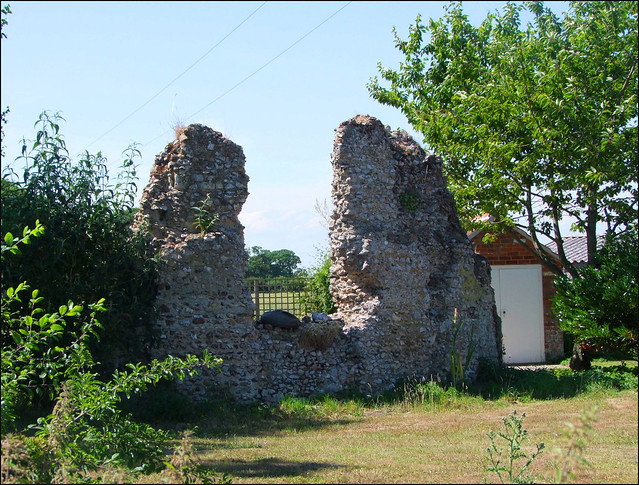
| The ruin
consists of a curved flint wall with a
tall gap running the height of it, like a
decayed tooth, about 4 metres high and 3
metres wide. I am afraid that I then made
an error, and described it in the first
version of this article as the
eastern face of the round tower, the part
that would have been inside the church.
Coming back, I could see that this was
not the case. In my defence, the first
time I had seen this ruin it was so
overgrown that I could not see that the
gap was not a former archway. The owners
have cleared the site up in the
intervening years, and you can clearly
see that this opening was, in fact, a
window. The wall is therefore something
more interesting than a round tower, it
is the curved apse of a Norman chancel,
more common in Norfolk than in Suffolk,
which only has a couple of survivors. The opening seems
to line up exactly on the nuclear power
station, probably giving credence to some
crackpot conspiracy theory that God was
an astronaut, or something. Looking at
the golfball dome again, I was sure I
could see it glowing faintly. Maybe the
old bloke with the dog had been right to
worry. However, ten years on we worry
more about the Da Vinci Code than we do
about extra-terrestrial life, and so it
was with a sense of ease that I turned my
bike, at last, in the direction of
Saxmundham railway station.
|
|
 |
|
|
|