| |
|
 |
|
Over the last couple of
centuries, the Borough of Lowestoft has
sprawled out to encompass a number of
historic parishes, including Gunton,
Pakefield, Oulton, Carlton Colville and
here, the former village of Kirkley.
Consequently, seven of the churches in
the Borough are medieval - or, more
strictly, of medieval foundation, for
there was a spectacular 19th Century
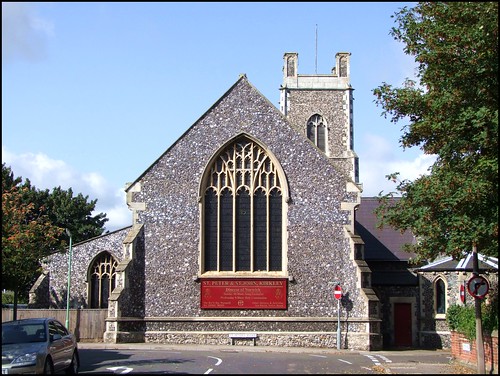
restoration here at St Peter and St John,
which has left very little of medieval
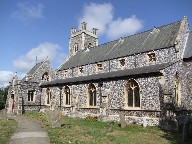
origin. The church, then
simply dedicated to St Peter, had been
abandoned in 1680, after more than a
century of neglect. The parishioners
moved in up the road at Pakefield, but when the two
parishes there were combined, and the
dividing wall was opened up, there was no
longer room for them. So they came back,
patched up this church, and suffered in
it for the next 120 years.
However, by the 1870s, when
Lowestoft had expanded and engulfed the
parish, the time had come for a total
rebuilding. Another church, the now
demolished St John, had been built in
the parish ten years before. But this was
not enough for the huge population, so St
Peter was built anew between 1874 and
1876 by the architect John Clemence. All
that survives of the medieval church is
the heavily restored tower, which once
stood at the west end, but the new
building was extended southwards, putting
it at the north-west corner.
|
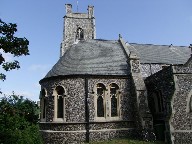
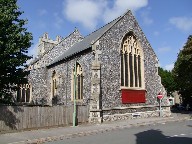
From
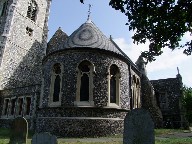
the north, it looks conventional enough. But on
the south west side there is a delightful
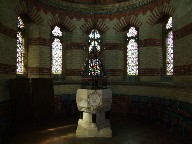
surprise; an apsidal baptistery, the work of Thomas Porter
in 1893. This is quite unfamiliar on an Anglican
church in Suffolk, although there is something
similar at St Edmund Catholic church
in Bungay.
Like
all churches, Kirkley Parish church continues to
reinvent itself. When St John was demolished in 1976, it
took on the current dual dedication. These days,
the name Kirkley is roughly synonymous with that
part of coastal Lowestoft south of the river,
which isn't entirely accurate. The main road to
Ipswich is a ratrun through the parish, giving it
an urban scale beyond its sizen. Off this parade
of busy little shops you find yourself in a
pleasant residential suburb. Towards the sea, the
houses are enormous. This area, Kirkley Cliffs,
is a rather pleasant seaside resort, usually
referred to as Lowestoft South Beach. Until quite
recently this was a fairly seedy area, but it has
undergone a huge improvement programme in the
last ten years, thanks to an injection of money
from the European Social Fund for deprived areas.
Before coming here, I had been chatting with the
man at South Lowestoft Methodist Church about
this. "A lot of local people think it was a
bit of a waste of money", he observed. But
now, Lowestoft's are the only beaches in Suffolk
to win Blue Flag awards, and are of a beautiful
golden sand. Why people would rather go ten miles
up the road to seedy, be-littered Great Yarmouth
beats me.
In
one of the large houses, now a guesthouse but
until recently a dentist's surgery, as it had
been for nearly a hundred years, one of the most
significant events in Kirkley's history occured.
In this house, on November 22nd 1913, a baby boy
was born to the wife of the dentist of the day.
This boy, their youngest child, would grow up to
be the most famous Suffolker of the 20th century,
and it is entirely appropriate that Benjamin
Britten should be born on St Cecilia's Day, for
she is the patron saint of music.
Britten
is more closely associated with Aldeburgh, Snape and Orford than Kirkley, not least
because of the music which was first performed in
the churches there. But it was at the High Church
St Peter and neighbouring St John that Britten
first experienced the power of the liturgy, and
church music first entered his consciousness.
There is a blue plaque on the house, but no other
fuss seems to be made of Britten in Kirkley; you
have to search to find him. At the northern end
of Lowestoft is the Benjamin Britten High School,
and, more surreally, the Benjamin Britten
Shopping Centre is in the centre of town. But
Kirkley seems rather reserved about its genius
son, who was certainly the greatest English
composer of the 20th century, and perhaps the
finest English composer of opera ever. He was
also one of the first establishment gay figures
to openly win acceptance, and he is buried today
beside his partner for 40 years, Peter Pears, in
the graveyard at Aldeburgh.
The
first time I came here, shortly after the start
of the new millennium, I walked around St Peter
and St John on its little hill, surrounded by
pleasant little terraced houses. They must have
been built at about the same time. The church
looked abandoned from this aspect, but I took
this to be merely another manifestation of the
urban shabbiness that Lowestoft in from the coast
seems to rejoice in. In fact, the noticeboard at
the east end, facing Kirkley High Street, showed
that this was a lively parish.
Before
I go any further I must tell you that this church
is now open every day, but back then it wasn't,
and it wasn't for almost another ten years that I
came back to Kirkley and tried to get inside
again. Actually, I did not have try very hard,
because I visited on the day of the Historic
Churches Bike Ride 2009. It is worth adding that,
having taken part in this event for more than
twenty years, I have a wide experience of the
kind of people who sit and welcome cyclists to
churches on this day. I can tell you, in all
honesty, that the people of Lowestoft are
probably the friendliest people I have ever had
any dealings with - and not just the church
welcomers. In shops and pubs, on buses and
trains, even when just walking down the street,
these are the kindest, most courteous people you
could possibly hope to meet. And yet... and yet.
When I turned up at their churches and asked to
see inside back on that Historic Churches Bike
Ride day of 2009, they looked at me as if I had
requested something really off the wall, like
wanting to examine the contents of their wallets.
I was treated with mild surprise and some raised
eyebrows when I asked to step past the welcome
desk into the body of the church. No one actually
refused, but you could tell that they thought I
was a little odd. But thankfully, those days are
now gone at Kirkley.
I
suppose it is a cultural thing. Most parishes see
their building as an act of witness in itself,
and that by keeping it open they offer a
prayerful space in the middle of a busy world to
passing pilgrims and strangers. Evangelical
churches are, not unreasonably, less likely to
take this approach - they want you to come on a
Sunday and join the Club, after all - but Kirkley
parish church is very much in the High Church
tradition, and it was a delight to finally set
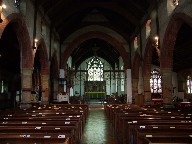
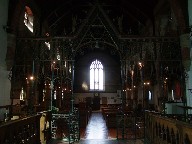
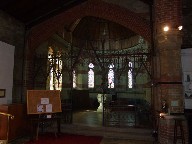
foot inside St Peter and St John. It is a big,
urban, late 19th Century Anglo-catholic space,
with white- and red-brick banding creating a
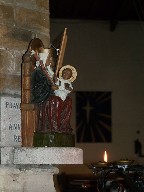
polychromatic effect, a candle flickering in
front of the statue of Our Lady of Walsingham by
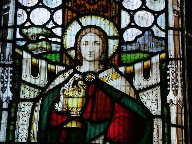
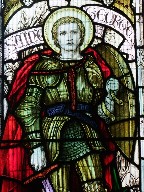
the south doorway, and jewel-like windows
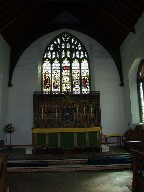
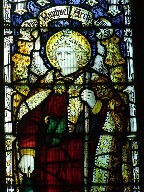
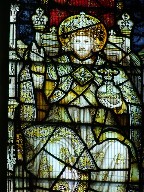
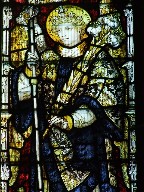
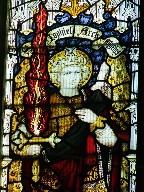
piercing through the gloom. The best is in the
east window, good Kempe glass depicting Christ in
Majesty flanked by the four archangels Michael,
Raphael, Gabriel and Jophiel.
To
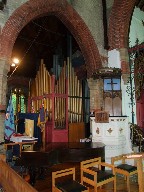
get to it, you step through the excellent
wrought-iron rood screen of the 1890s. On the
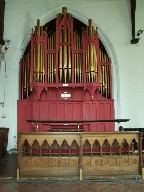
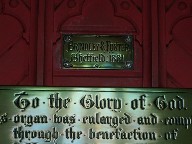
north side of the chancel is the organ where
Benjamin Britten's mother came to practice on
weekday afternoons, the small boy sitting beside
her and turning the pages. It is apparently one
of the few four manual organs in Suffolk.
There
is, of course, no tower arch, and a great clock
ticks steadily at the west end of the nave. The
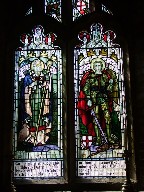
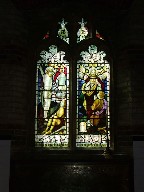
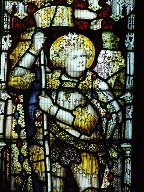
Ward & Hughes glass down the south aisle is
not the workshop's best, but contributes to the
feel of a faded, early 20th century
Anglo-catholicism which is being lost to us by
reorderings and redecorations elsewhere. One set
forms the war memorial window, a touching moment.
At the west end of this aisle is the church's
most memorable feature, the open baptistery with
its wrought iron screenwork and spectacular
marble font. I did try to imagine the infant
Britten being dipped into it, but I suspect that
he was actually baptised at the now-demolished St
John. The nice lady on duty, seeing me gazing at
the font, came and apologized for its dusty
state. "The whole church has got so dirty,
and it needs a thorough redecoration. But it is
so expensive, and there are so few of us left
now." I told her that I rather liked it the
way it was, but I suspect that was small comfort.
One
intriguing survival is the small reredos made by
Robert Anning Bell for St Peter's church in north
Lowestoft, which was demolished, along with St
John, in the 1970s. The rationalisation of
Lowestoft's Anglican churches at that time
bolstered congregations in the churches which
survived, and long may they continue to do so.
|
|
|