| |
|
 |
|
Haverhill once had a
reputation for being the poorest and
scruffiest of Suffolk towns, but over the
last few years this reputation has become
very ill-deserved. The main street has
been pedestrianised with attractive
public sculptures, and coming here on a
Saturday morning after a couple of years
absence I thought it now a busy little
place, the market in full swing and
people from the country villages chatting
on the benches and in the cafés.
Haverhill is surrounded by the loveliest
area of East Anglia, with attractive,
secretive villages huddling in the gently
rolling hills, but for too long the town
has been the hole in the middle of the
doughnut. Many people could
tell you that the big four towns of
Suffolk are Ipswich, Lowestoft, Bury
and Felixstowe;
few would know that Haverhill is the
fifth biggest, I suspect. It gets
something of its character from its
proximity to Cambridge, where many people
go to work, but it escapes the character
of a dormitory town by retaining its
industrial base.
|
On
the streets, as in any East Anglian town, you
hear the local accents competing with Eastern
European tongues, but there are also older people
with the voices of the East End, for Haverhill
was, like Sudbury, a London overspill town.
Unusually, the borough boundaries are marked by
borders with two other counties, Cambridgeshire
and Essex. Indeed, the industrial area of
Haverhill is partly in Essex, although beyond it
are some of the loveliest parts of that
equally-maligned county, the Bumpsteads and the
Sampfords, and the gentle clay country stretching
away from more familiar East Anglian chalk
uplands.
One
might conclude that, although Haverhill is in
Suffolk, it doesn't feel of it, and
there is no doubt that the town is still
uncharacteristically poor, especially when
compared with nearby Newmarket. In
Suffolk, we expect that the further west we go
the richer it gets, but Haverhill is very much
the exception that tests the rule.
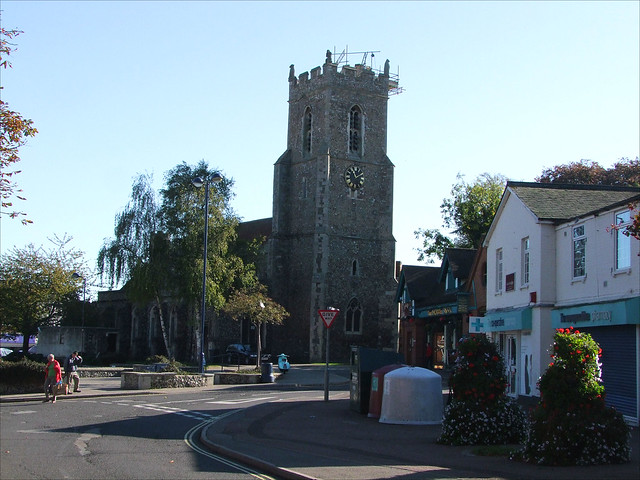
When
I last came this way, St Mary's church was
undergoing a refurbishment, and because of this I
was not able to get inside. That is now complete,
and this church is open every day. Externally,
the two most notable features are the Stour
Valley stair turret that rises above the level of
the tower top, and the rood loft stair turret, as
at nearby Clare and Stansfield. However,
when you learn that, as at Beccles and Bungay, the
interior was effectively scoured by a major town
fire in the 17th century, and little survived,
you might not have high expectations.
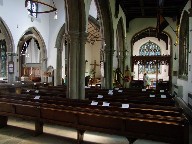
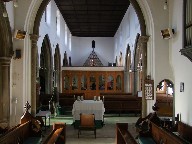
In
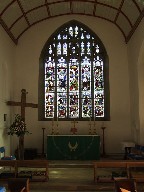
fact, the interior is rather wonderful. The
western third of the nave has been filled with a
wood-and-glass-walled café, which sits neatly
beween the arcades without imposing too much. The
chancel and chapels to the east are bright and
richly coloured in the Anglo-catholic tradition.
Everything has been restored and renewed in the
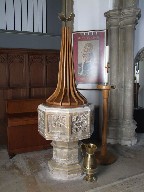
makeover of the early 21st Century. The font,
with its excellent cover by Frederick Gibberd,
famous as the designer of the Catholic Cathedral
in Liverpool but also the architect of
Haverhill's considerable post-war expansion, has
been moved into the east end of the north aisle.
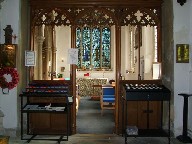
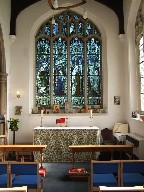
The south aisle chapel is stunning; the blessed
sacrament is reserved here, and rows of candles
burn in front of the screen. I found it very
difficult to take photographs, simply because a
constant succession of people were coming in to
light candles. It really felt as if this was the
beating spiritual heart of the town around it.
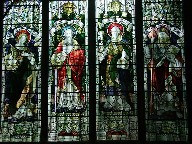
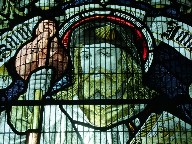
The
windows are filled with coloured glass. The
life-sized figures in the south aisle must always
have been imposing, and with the space within the
nave shortened they dominate rather uneasily.
Perhaps I was just not used to them. There is
also a portrait of the puritan hothead Samuel
Ward, famous as town preacher of Ipswich. But
during the Commonwealth he had fulfilled the same
role here, and his father was Rector. Haverhill's
puritan credentials were confirmed in the 19th
Century, when it was a hotbed of non-conformism.
This was to such an extent that, in a town of
more than 3,000 people as it was in 1851, the
Census of Religious Worship that year recorded a
regular congregation at St Mary of of barely 200,
about 8% of the population and the lowest rate of
Anglican observance in any East Anglian town.
This compared with more than 500 at the Baptist
chapel, and another 500 at the Congregational
chapel.
| Haverhill's enthusiastic
non-conformism would result in the
building later in the century of
Suffolk's most spectacular
Congregationalist church, the bespired
and beturreted palace at the Sturmer end
of the town centre, now the United
Reformed Church. Visitors may easily
confuse it with the parish church, which
keeps rather a lower profile at the other
end of the High Street. I left Haverhill
under the railway arches of the former
Colchester to Cambridge line - but the
railway has gone now, killed in the 1960s
when oil prices were low and motorways
seemed an exciting idea. Now, Haverhill
is one of the largest towns in England
without a rail service, and anyone
wanting to travel by train between
Colchester and Cambridge, two of East
Anglia's largest towns, must either go
via London or dot about on Ipswich and
Bury local services for a couple of
hours. So short-sighted.
|
|
 |
|
|
|