Phipson
liked spires. Two of Suffolk's most famous are
his. At Woolpit, he added an astonishing
Nene Valley spire to the grand medieval church
there. At Great Finborough, he did something even
more extraordinary, which one can only put down
to the influence of laudanum, or whatever the
drug of choice of the 1860s was. He is also
responsible for the landmark St Mary le Tower in the centre of Ipswich.
Here
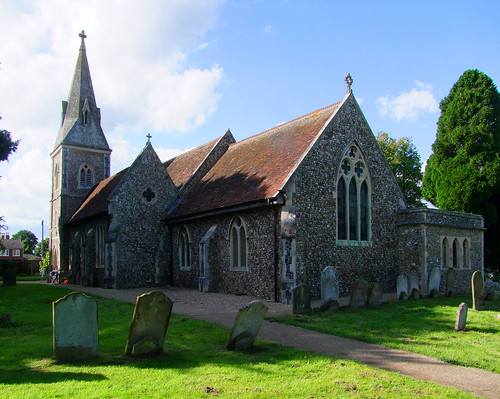
is a spire on a small scale. Indeed, this could
be said of the whole church. Here is the 19th
century Gothic revival built tiny. Even before
Frederick Barnes' restoration of the 1850s, this
was a little church, and today I can't help
thinking of this as a toy church, as if it had
been built by some rich parent for a fortunate
child. It has everything you'd expect: tower,
nave, aisles, chancel. Everything about it is
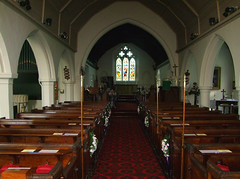
just perfect, and the interior is jewel-like.
This is certainly the prettiest church in the
borough of Ipswich.
You
will have to find it. Whitton's village centre
was on the old Norwich Road, closer to Claydon
than to Ipswich. There are still a few surviving
18th and 19th century buildings. But what has
happened to this parish is completely
overwhelming. Today, the old village centre is
surrounded by the northern suburbs of Ipswich.
You reach it by turning off of the Norwich Road
at the traffic lights, just before the Whitton
United football ground and the vast Asda
superstore, and continuing until the houses get
old. No one would ever know that this was once a
hamlet.
Ipswich
does not make a habit of swallowing villages;
most of the borough is built on former heathland.
So here is something unusual. In the 19th
century, you would have travelled up Whitton
Church Lane through the fields, reaching St Mary
after a half a mile or so. You can still make
this journey today; but the fields have gone.
Instead, you pass the huge Whitton sports
complex, and cut across the edge of the Whitton
estate, one of Ipswich's three large, poor
council estates. In 1841, the population of this
parish was 422, which included a large wedge of
northern Ipswich. Today, it is a little short of
25,000.
You
can walk or cycle, or even drive if you must,
from the centre of Ipswich to this church. You
cross the ring road, with its large, comfortable
houses, and as you head north up Dale Hall Lane
into Castle Hill, the houses get smaller. At
Castle Hill centre, among the well kept blocks of
flats and former council semis, you will notice
the fine United Reformed Church, one of Ipswich's
best 1960s buildings, before continuing onwards.
At once, it gets poorer, the houses scruffier,
the roads narrower. Groups of kids spill their
games onto the streets, shouting at you cheerily
as you cycle past. Eventually, you reach the
streets poignantly named the Poets, and here is
the high-rise Thurleston High School, now
rebadged as the Ormiston Endeavour Academy, the
medium-rise tenements, the urban maze of streets.
I am afraid that it amuses me to see wide-eyed
rural cyclists scurrying through all this on the
Historic Churches Bike Ride. They've chosen this
route into town to pick up Whitton church, and
now they are travelling through an aspect of
Suffolk that they had never even imagined
existed.
Suddenly,
you reach the church - and, surreally, there is
open countryside ahead of you. You can just make
out Akenham church in the distance. After all
this, you will be a bit breathless, I expect.
Take a moment to look around. The pretty
churchyard extends to the east, and some large
monuments to former worthies fill the narrow
space between the west end and the fence. One of
them is to the Reverend Howorth, who oversaw all
the massive changes that happened to this
building. Unusually, the main entrace is at the
south-east corner, and the doorway is the only
survival from the medieval church. Obviously, it
was not in the tower originally.
Because
this is the second most-populous parish in
Suffolk after that of St Francis on Ipswich's Chantry estate,
there's a fair chance that if you visit on a
Saturday you'll be looking inside just before or
after a wedding. My first visit in 1999 came on
the Friday of Easter week, and two of the members
of the Parish were preparing the building for a
wedding. They were filling it with flowers, and
erecting an ornate archway of greenery at the
west end. This church is such a contrast with the
grandeur of the Ipswich town centre churches, but
I thought it was just about perfect. Coming back
in 2015 I caught the tail end of a wedding,
everyone in their best frocks and suits, and
waited for them to spill outside for the
photographs before venturing inside.
You step into a
breathtakingly beautiful interior.
Coloured light spills from tiny windows.
Ikons gleam, and the occasional candle
flickers. This is a church in the Affirming
Catholicism wing of the Anglo-Catholic movement, and has
a devotional atmosphere. Everything is
simple, but of the highest quality.
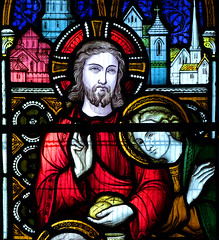
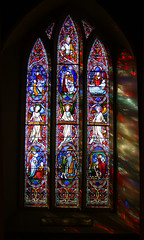
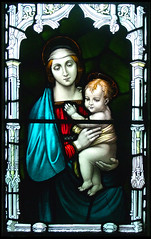
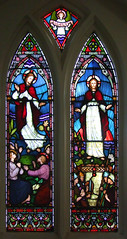
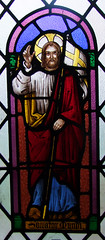
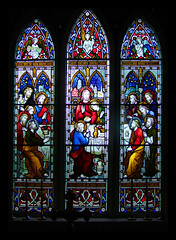
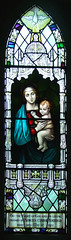
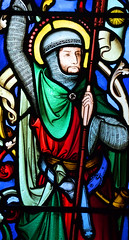
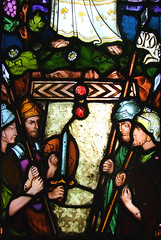
This church has the best
19th century windows in Ipswich. Some of
the glass is by William Morris & co -
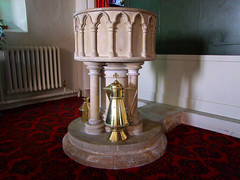
that by the font at the east end of
the north aisle is heart-breakingly
lovely. There is a good window by
Frederick Preedy depicting Faith, but
much of the glass in the church is by
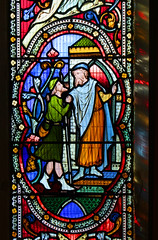
Hardman & Co, including a spectacular
Seven Works of Mercy at the west end. A
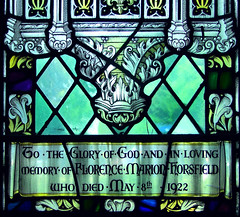
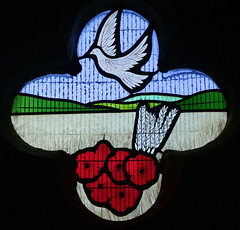
recent memorial in glass at the east end
of the south aisle is unsigned - I wonder
who it was by? The organ behind the font
was a recent acquisition; it came from a
Baptist church in Cambridge. As the
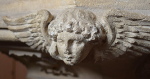
churchwarden pointed out, the gold angels
on top of it are a Whitton addition.
This parish is a busy one.
As at St Mary at Stoke, massive 20th
century expansion of the town has meant
the church is blessed with a fair-sized
congregation, and a busy liturgical life.
But in a place like Whitton, the church
has a greater pastoral mission than
simply putting on services. Here, it is
at the cutting edge of being the body of
Christ to the people of God, in this most
needy and challenging of East Anglian
parishes.
|
|
 |
Simon Knott, 1999, revised and updated May 2016
|
|